Dosan Media
도산 안창호 기록관
No. 1 of 4
Riverside, California
Taken January 1912. Published as 1904, 1905, 1905–1911
The Same Photograph
One photograph of Dosan with orange pickers, dated three different ways by three institutions, none of them right. He has a mustache in it. He had no mustache until after 1911.
The leader
UC Riverside says 1904. UCLA says 1905. Both false. The date is 1912.
This photograph of Ahn Chang Ho with orange pickers of many ethnic backgrounds is not from 1904 or 1905 as UC Riverside and UCLA claim. It was taken in January 1912 before Dosan left Riverside for San Francisco. Dosan is the third man from left, with a mustache. Look at the picture of Dosan from 1905: clean shaved. Dosan had no mustache until after 1911.
This picture was first exhibited and published in the Helen Ahn Collection in the 1980s in Los Angeles. It was archived in 1982 and sent to Korea in 1984. I know this collection keenly. I am the only manager of it. The contract is on record with the South Korean Government. Almost every image UC Riverside uses originated from the Helen Ahn Collection I manage.
Philip Ahn Cuddy
Look at these two
Photograph · 1905 · San Francisco, California
Song Jong Ik, Dosan and Pang Hwajung, San Francisco, 1905
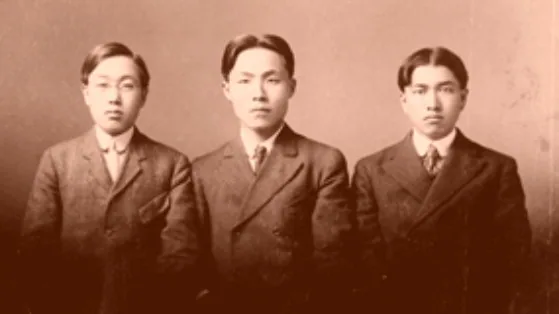
The earliest picture of the Kongnip Hyophoe (Mutual Assistance Association), San Francisco, 1905: Song Jong Ik, Dosan, Pang Hwajung. Dosan, centre, clean-shaven. He had no mustache until after 1911.
A picture is worth a thousand words. DOSAN DID NOT HAVE A MUSTACHE in 1905. How could the orchard photograph, in which he has one, be taken in 1904 or 1905? UCLA and UC Riverside both boast that UC employees are prolific researchers.
The orchard picture was taken in January 1912 before Dosan left Riverside for San Francisco. Then the Great Freeze of late 1912 and 1913 shut down Korean labor in the citrus industry for years. Koreans fled Pachappa because there was no work; Koreans were the last to be hired. In 1920 there were 20 Koreans in Riverside.
Philip Ahn Cuddy · Verified primary record
Photograph · 1908 · Korea
Dosan, Korea, 1908
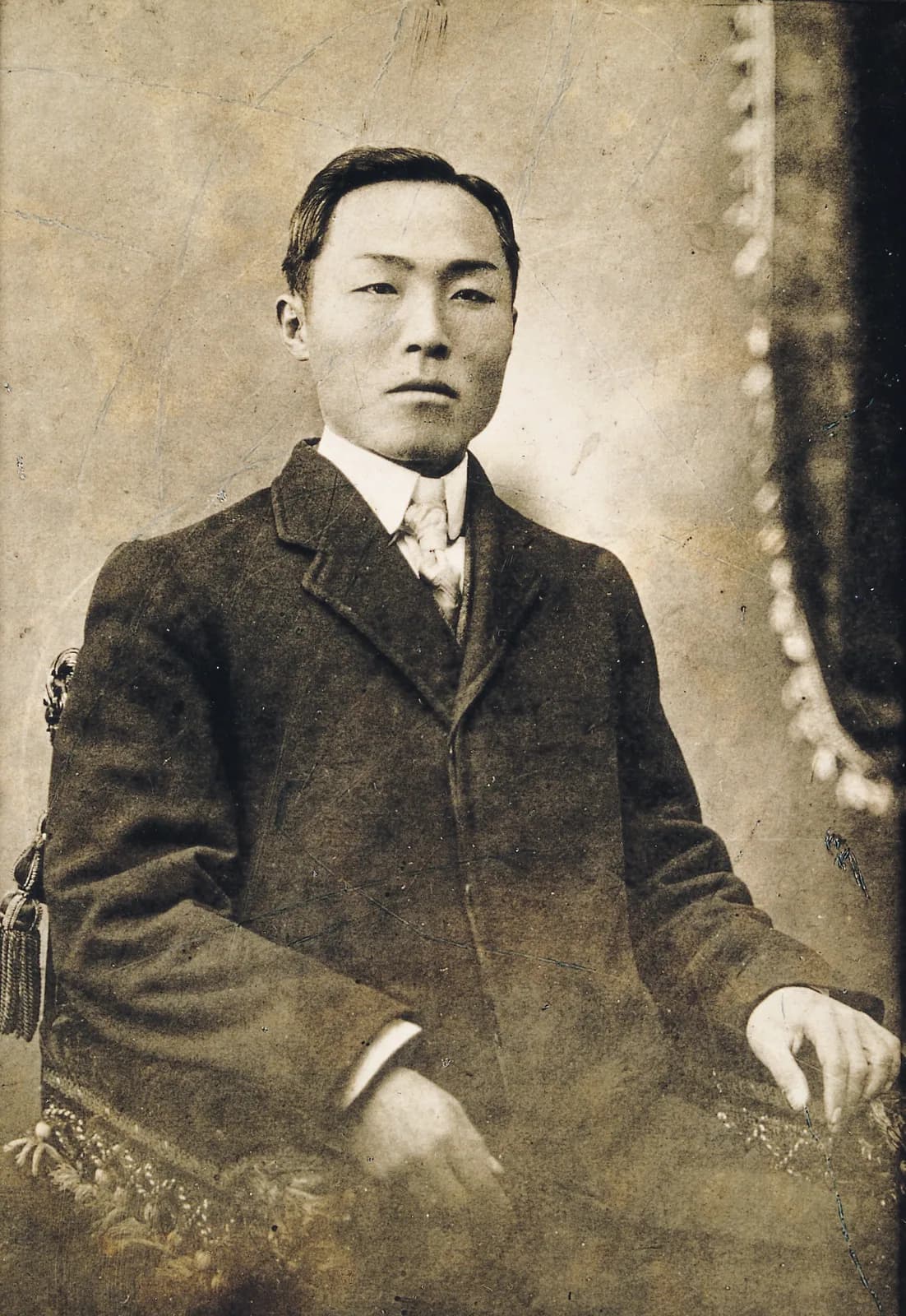
Dosan seated in a photographer's chair, Korea, 1908. Clean-shaven. The second of three dated portraits in this paper: 1905 San Francisco, 1908 Korea, January 1912 Riverside.
Look at the three together. The mustache arrives after 1911. The orchard photograph has it. UC Riverside says the orchard photograph is 1904.
Philip Ahn Cuddy · Captioned '1908 Korea' on slide 6 of Press-Conference-Pachappa.pptx (Philip Ahn Cuddy) · Verified primary record
The lead record
Photograph · Date of publication not established · Riverside, California
Twenty men in an orange grove
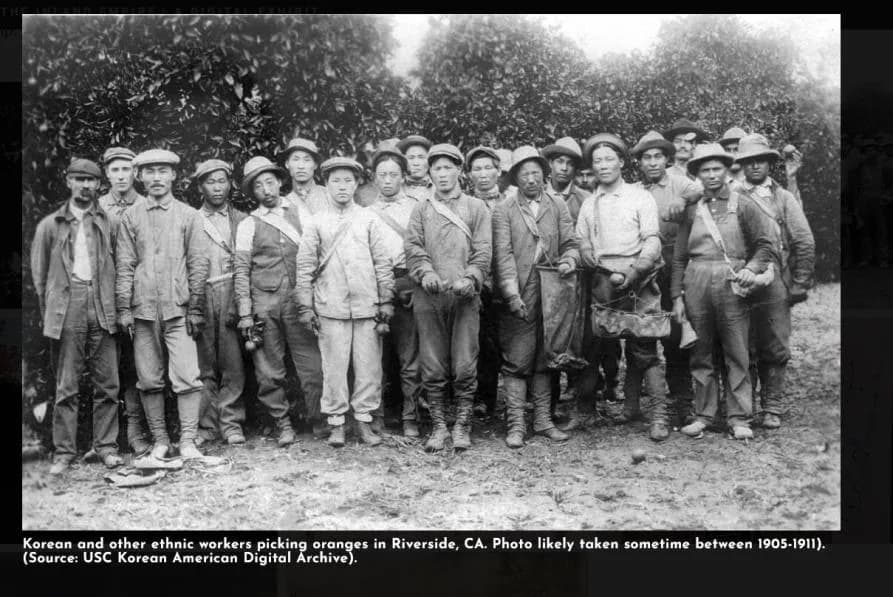
Twenty men stand in a row before a hedge of orange trees, picking bags and tools in hand. Published by a digital exhibit of the Inland Empire, whose caption dates the picture to "sometime between 1905-1911" and calls the group "Korean and other ethnic workers".
The caption reads, in full: “Korean and other ethnic workers picking oranges in Riverside, CA. Photo likely taken sometime between 1905-1911. (Source: USC Korean American Digital Archive).”
This is the clearest reproduction in print. It is also the only published caption that does not name Dosan, and the only one that says the men are not all Korean.
The records that follow are this same photograph, published elsewhere, dated differently each time. A pair of clippers lies on the ground at the front left; they are the quickest way to check two copies are one picture, and they appear in every reproduction that has not been cropped at the foot.
It was taken in January 1912, before Dosan left Riverside for San Francisco, in a series of photographs made to advertise Korean labor in the Shinhan Minbo. Dosan is third from left, with a mustache. He had no mustache until after 1911. Look at the 1905 Kongnip Hyophoe photograph in this paper: clean-shaven.
Once is a mistake. Twice is a choice. How many is a lie?
The Inland Empire: A Digital Exhibit · Screenshot of the exhibit's published caption, reproduced for comment. The photograph is credited there to the USC Korean American Digital Archive. · Corroborated by a second source
The rest of the file
Photograph · 10 November 2021 · UCR Arts, Riverside, California
The same photograph on the gallery wall, dated 1904
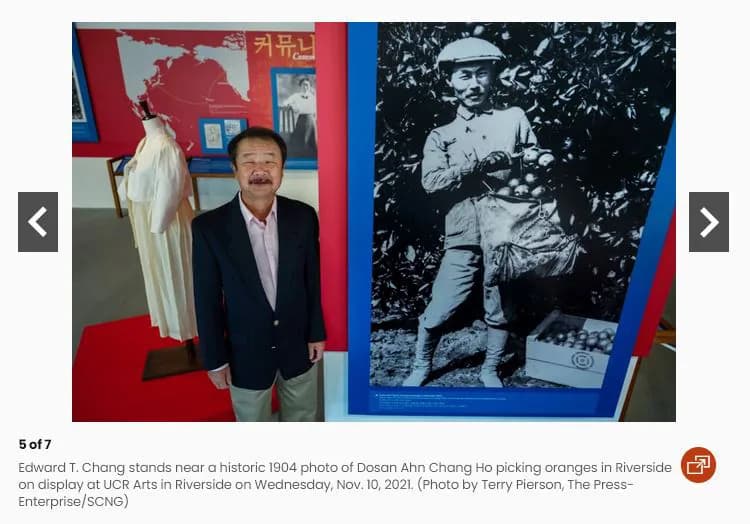
Edward T. Chang photographed beside the orange-picking photograph at UCR Arts, where it was reproduced at wall height for the Pachappa Camp exhibition. The newspaper's caption dates the picture to 1904.
The caption reads, in full: “Edward T. Chang stands near a historic 1904 photo of Dosan Ahn Chang Ho picking oranges in Riverside on display at UCR Arts in Riverside on Wednesday, Nov. 10, 2021. (Photo by Terry Pierson, The Press-Enterprise/SCNG)”
1904 is the earliest date any publication has given to any of this material. It is also the only one given without a hedge: not “around”, not “likely”, not a range.
The Press-Enterprise / SCNG · Screenshot of the newspaper's published photograph and caption, reproduced for comment. · Corroborated by a second source
Photograph · 19 October 2016 · Riverside, California
The same photograph, dated “around 1905”
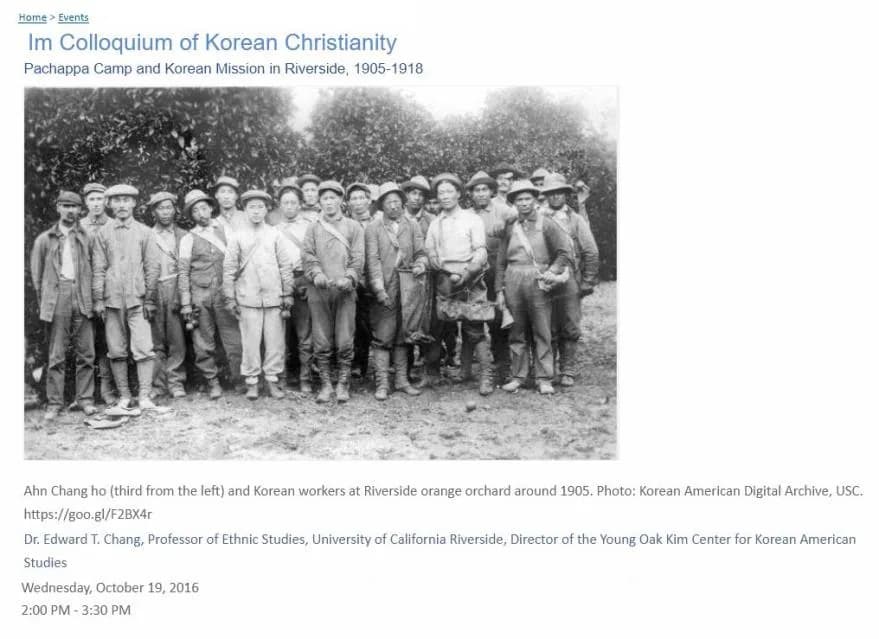
The listing for a 2016 colloquium at which Edward T. Chang spoke on “Pachappa Camp and Korean Mission in Riverside, 1905-1918”. The photograph beneath the title is the one that leads this paper, dated here to a single year.
The caption reads: “Ahn Chang ho (third from the left) and Korean workers at Riverside orange orchard around 1905. Photo: Korean American Digital Archive, USC.”
Two differences from the copy above, which names the same USC archive as its source. This one identifies Dosan in the row, and calls the men Korean workers rather than “Korean and other ethnic workers”. It also settles on a year where the other gives a six-year range.
The listing dates itself: Wednesday, October 19, 2016, 2:00 PM to 3:30 PM.
University of California, Riverside · Im Colloquium of Korean Christianity · Screenshot of the colloquium listing, reproduced for comment. The photograph is credited there to the Korean American Digital Archive, USC. · Corroborated by a second source
Photograph · Published 2021, per the copyright line on the photograph · Riverside, California
The same photograph, cropped to seven men
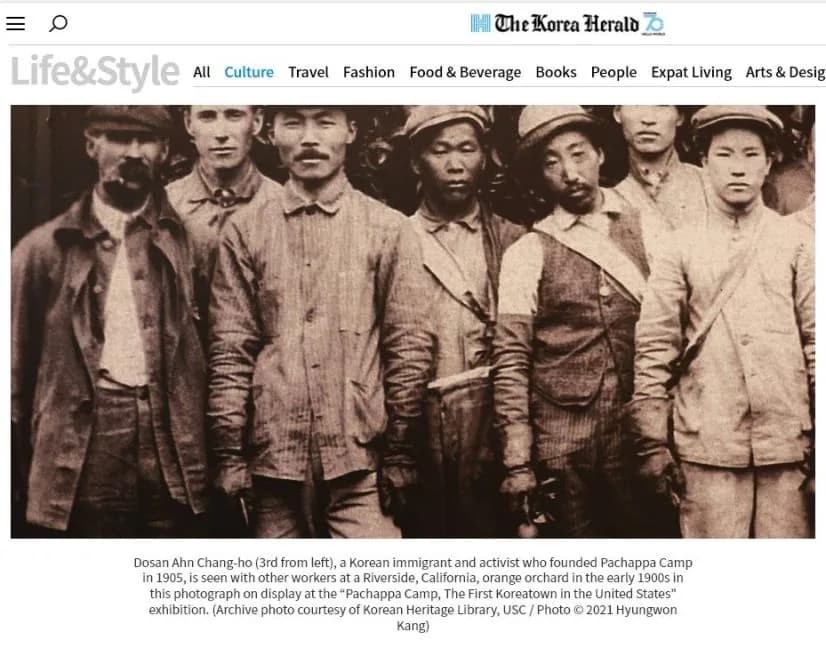
A crop of the same photograph in the Korea Herald's Life&Style section. The caption dates it to “the early 1900s” and states, without qualification, that Dosan founded Pachappa Camp in 1905.
The caption reads, in full: “Dosan Ahn Chang-ho (3rd from left), a Korean immigrant and activist who founded Pachappa Camp in 1905, is seen with other workers at a Riverside, California, orange orchard in the early 1900s in this photograph on display at the ‘Pachappa Camp, The First Koreatown in the United States’ exhibition. (Archive photo courtesy of Korean Heritage Library, USC / Photo © 2021 Hyungwon Kang)”
The crop keeps the seven men at the left of the row and drops the rest. The first of the seven is the man the caption on the lead record accounts for by describing the group as “Korean and other ethnic workers”.
Credited here to USC's Korean Heritage Library. The two copies above credit USC's Korean American Digital Archive.
The Korea Herald · Life&Style · Screenshot of the Korea Herald's published caption, reproduced for comment. The archive photograph is credited there to the Korean Heritage Library, USC. · Corroborated by a second source
Photograph · Date of publication not established · Riverside, California
The same photograph in Korean, with a second man named
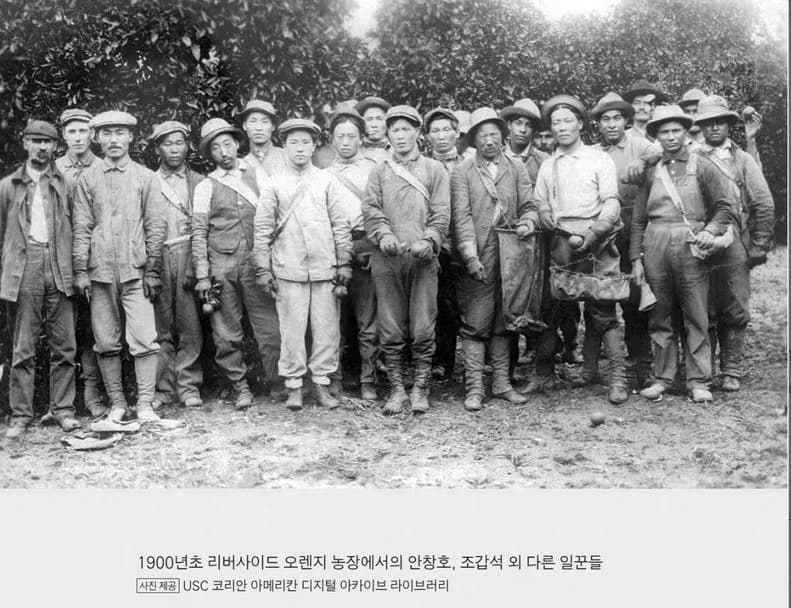
The full photograph again under a Korean caption crediting USC's Korean American Digital Archive Library. It dates the picture to the early 1900s and names a second man in the row, Cho Kap-seok.
The caption reads: “1900년초 리버사이드 오렌지 농장에서의 안창호, 조갑석 외 다른 일꾼들” — Ahn Chang-ho, Cho Kap-seok and other workers at a Riverside orange farm in the early 1900s. The credit line reads 사진 제공 USC 코리안 아메리칸 디지털 아카이브 라이브러리.
The clippers are on the ground at the front left and the row of men is identical to the copy that leads this paper.
This is the only caption of the five that names a second man in the photograph. None of the English captions do.
Publication not identified · Screenshot of a published Korean-language caption, reproduced for comment. The photograph is credited in it to the USC Korean American Digital Archive Library. · Corroborated by a second source
Photograph · Date of publication not established
The same photograph, dated circa 1912
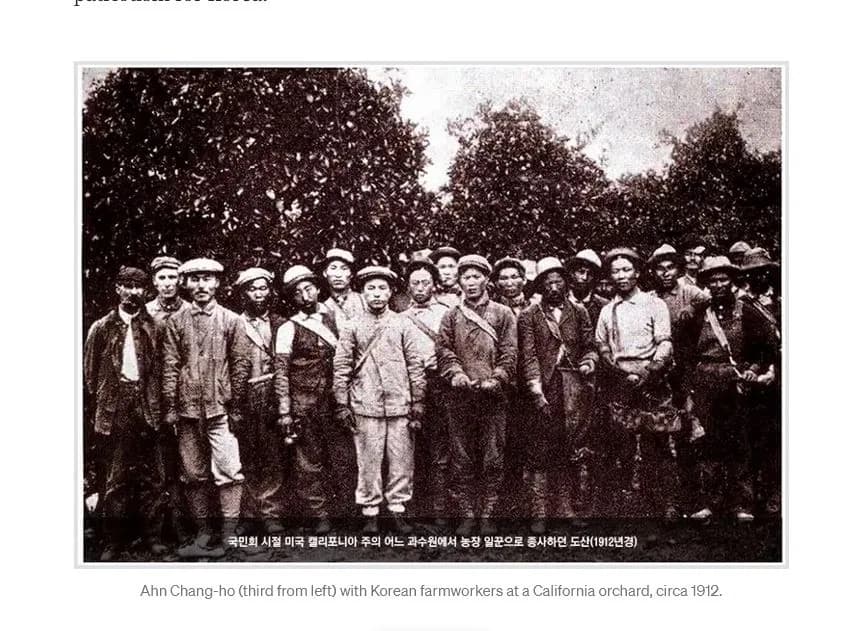
The same row of men again, dated “circa 1912” and placed at “a California orchard” rather than Riverside. The family identifies the page as a high school student project from outside California, and holds it up as the one that got the year right.
The English caption reads: “Ahn Chang-ho (third from left) with Korean farmworkers at a California orchard, circa 1912.” The Korean caption inside the frame reads “국민회 시절 미국 캘리포니아 주의 어느 과수원에서 농장 일꾼으로 종사하던 도산(1912년경)”.
This is from a high school student project outside of California. 1912 is the correct year. It was taken in January before Dosan left for San Francisco.
Held as a draft until the school and the year of the project are named, so a reader can check it the way they can check the others.
Unidentified high school student project · Screenshot of a page the family identifies as a high school student project from outside California. The project itself is not named. · Corroborated by a second source
Photograph · Date not established; published datings range from 1904 to 1912
The orange-picking photograph
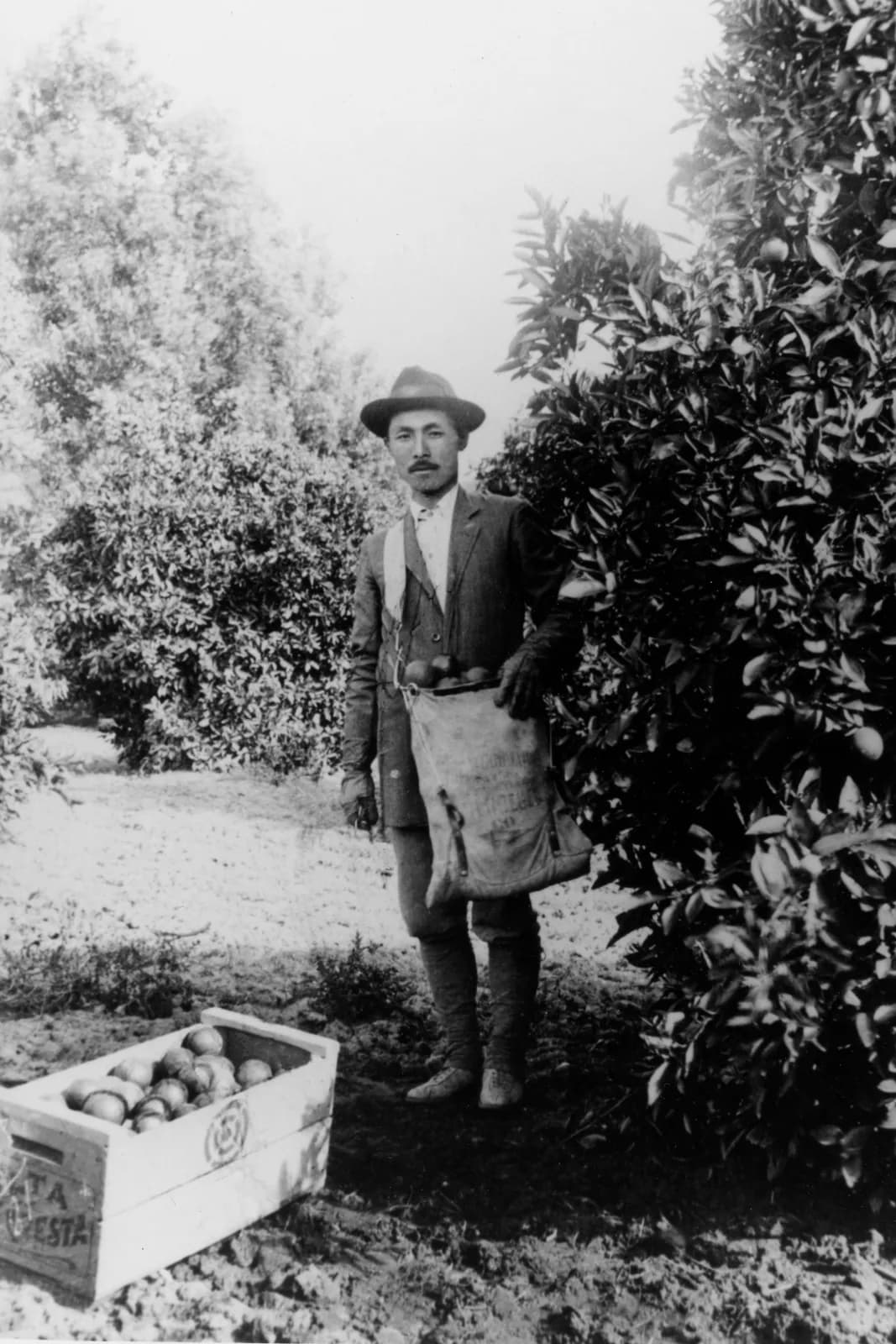
A man in a jacket, waistcoat, collar and tie stands at the edge of a row of orange trees with a picking bag at his waist and a filled crate placed in the frame beside him. This is the image the Pachappa Camp exhibition was built around.
What is in the picture: a felt hat, a jacket and waistcoat over a white collar and tie, a glove on the right hand and none on the left, laced boots, a picking bag holding perhaps a dozen oranges, and a stencilled crate on open ground at the end of the row.
Posed. It is one of the series of photographs taken in Riverside in January 1912 for advertisements recruiting Korean labor in the Shinhan Minbo in San Francisco, not a snapshot of a day's work. The published datings run from 1904 to 1912; the record that follows shows the earliest of them printed at wall height in a gallery.
Philip Ahn Cuddy · Held, not yet sourced
Document · July 1911 · Berlin
He did not pick oranges in 1911, or anytime
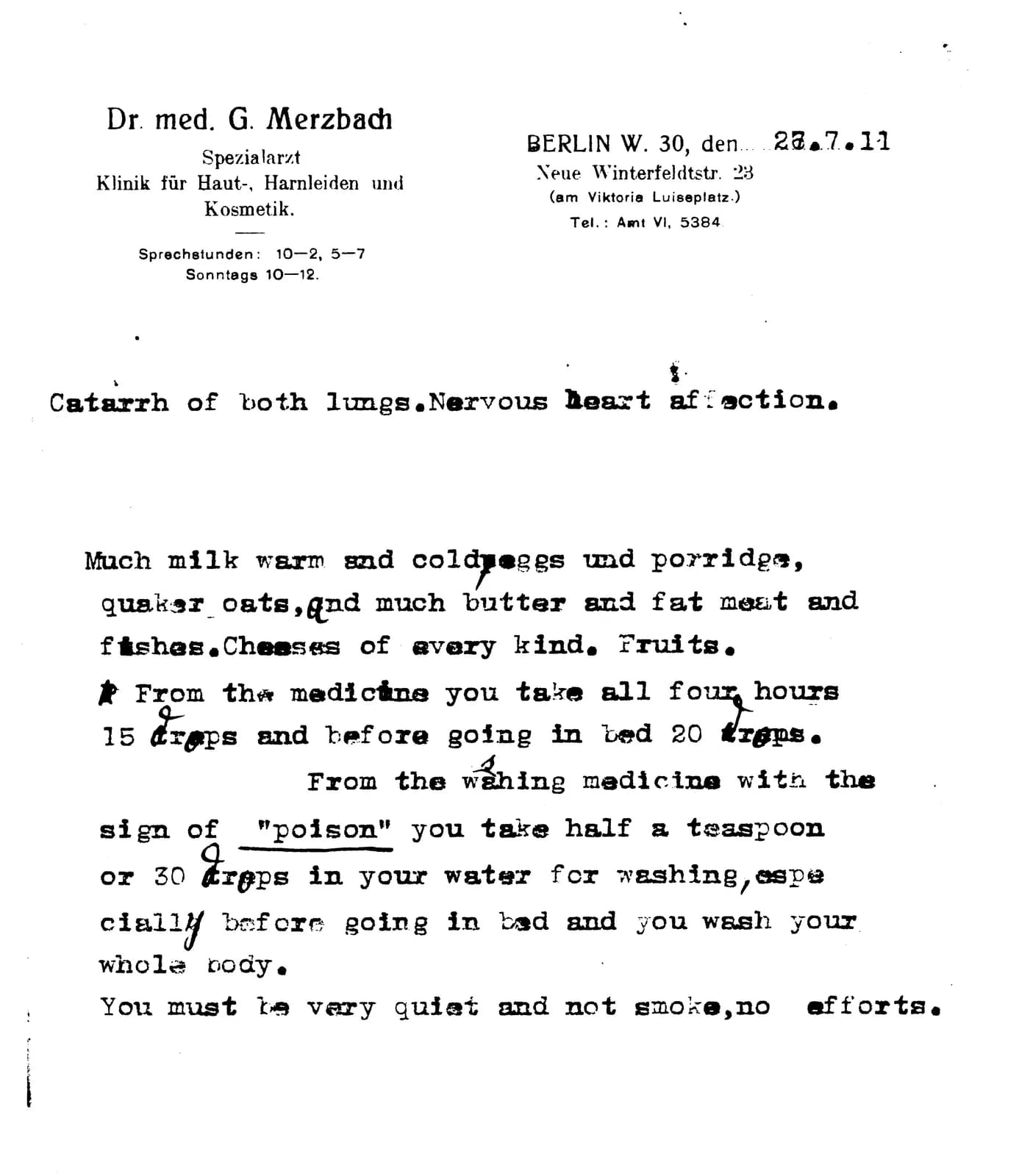
A Berlin doctor's note, July 1911: catarrh of both lungs, nervous heart affection, "you must be very quiet and not smoke, no efforts." Read Dosan's health problems. Six months later UC Riverside has him out in the orchard picking oranges.
For years Dosan suffered from complications of being tortured by the Japanese after he was arrested and jailed on the charge of organizing the 1909 Ahn Jung Gun assassination of Ito Hirobumi. He did not pick oranges in 1911 or anytime. The orchard pictures are posed pictures for a Sinhanminbo ad for Korean labor.
Dr. med. G. Merzbach, Berlin, July 1911, typed in English. It also puts Dosan in Europe on his way back from Korea that summer, which is where the mustache in the orchard photograph comes from. From the family papers.
Philip Ahn Cuddy · Verified primary record