The City Council adopted the designation on 28 February 2023 (see What happened next). Below are six places where the City’s file and the documents disagree. Each one has the page, the paper beside it, and what follows from it. After them come three sections on the City’s later papers: the final staff report, the email the City was sent and what the Commission and Council did next. Then comes the file itself: how it was built, the survey the application leans on, its photographs and its maps.
Page numbers are PDF pages of the July 2021 City file, page 1 being the cover of the recommendation report, unless marked “final”, which means a PDF page of the 171-page final packet (see Background). Quotes from the City file are copied exactly. Statements by Philip “Flip” Ahn Cuddy, grandson of Dosan Ahn Chang Ho, are marked as his.
What the file gets wrong
- 01The 1936 purchase has no source. A 1932 permit names an owner, John P. Lem, whom the application does not mention.
- 02A City Hall memorial that was held in a church.
- 03A 1909 caption for children who were not yet born.
- 04Helen Ahn’s photograph, the family says, shows another family.
- 05Three buildings, none tied to him before he left.
- 06A headline cited without its last word.
Further down: what City staff concluded, the City was told, what happened next, how the file was built, the survey the application leans on, the photographs, the maps, two timelines, the file against itself, what the file gets right, and a table on the paperwork.
Background
Dosan Ahn Chang Ho was born in 1878 near Pyongyang and emigrated to San Francisco in 1902 (p. 4). He became a leader of the Korean independence movement and, in 1919, acting premier of the Korean Provisional Government in China (p. 4). He founded the Hung Sa Dahn, or Young Korean Academy, in San Francisco in 1913 (pp. 15, 21).
According to the application, his family was in Los Angeles by 1914 (p. 17). He left Los Angeles for the last time in 1926 (p. 17). He died in Seoul on 10 March 1938 (The New Korea, 17 March 1938).
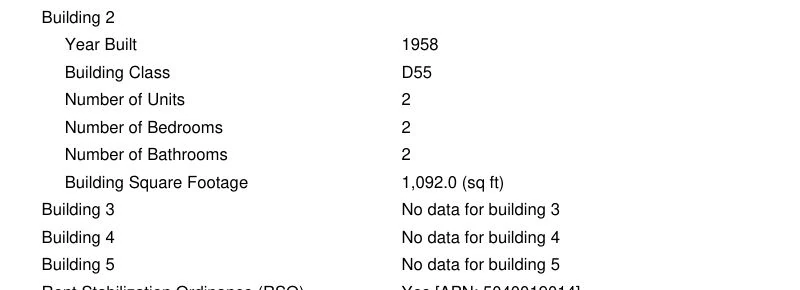
The house is a two-story Craftsman built in 1910, with a duplex behind it built in 1958 (p. 12). The July staff report says the Hung Sa Dahn used it as its headquarters from 1936 to 1978 (p. 3); the final staff report says 1936 to 1948 (final p. 4, below).
The July file is a Department of City Planning recommendation report and an application asking that the property be declared a Historic-Cultural Monument, for the Cultural Heritage Commission hearing of 15 July 2021 (p. 1). It has two parts.
Pages 1 to 5 are the staff report by City Planning. Pages 6 to 91 are the application the nominators submitted: Michelle Magalong (applicant), with Rosalind Sagara and Katherine Kim (preparers). Their text is on pp. 12 to 23; the rest is the form, photographs, permits, maps, clippings, a memoir by Dr. Marn Cha and a ZIMAS report.
There are two versions of the staff report. This article annotates the July 2021 file, and its page numbers refer to that file. The City later issued a final packet of 171 pages for the Cultural Heritage Commission hearing of 4 November 2021.
It holds a new final staff report (final pp. 2 to 8), correspondence from the owner’s representative (final pp. 54 to 80), the July staff report (final pp. 81 to 85) and the same application, unchanged (final pp. 86 to 171). The packet also has an index (p. 1), site inspection photographs (pp. 9 to 52) and a notice of exemption (p. 53).
The application’s pages sit in the final packet at the July page plus 80: July p. 15 is final p. 95, and July p. 47 is final p. 127. Page numbers marked “final” refer to the packet.
The 1936 date and the “direct efforts” are statements in the application (p. 15); the staff report’s summary also gives the 1936 date (pp. 3, 4). The July staff report does not test them. It recommends that the Commission take the property under consideration because the application and photographs suggest the submittal warrants further investigation
(p. 2), and it finds that the property may be significant enough to warrant further investigation as a potential Historic-Cultural Monument
(p. 5).
The July report asked the Commission only to take the property under consideration. The packet says the Commission voted to take the subject property under consideration
on 15 July 2021 (final p. 8). The final report is the next stage and asks the Commission to Declare the subject property an Historic-Cultural Monument
(final p. 3). What it rests on is set out in What City staff concluded.
Exhibit 1 | Application, pp. 15, 21, 63
The 1936 purchase has no source. A 1932 permit names an owner, John P. Lem, whom the application does not mention.
the building’s acquisition was facilitated through his direct efforts
Application, p. 15
In 1932 Dosan Ahn Chang Ho was not in Los Angeles. He had left the city for the last time in 1926 (pp. 4, 17). Page 17 of the application says he planned on returning to the U.S. in 1932 to spend time with his family
, and that repeated arrests by Japanese colonial authorities in 1927, 1932, and 1937 thwarted his efforts
.
The application says the family was in Los Angeles by 1914 (p. 17). In the application’s telling the Hung Sa Dahn he founded in San Francisco in 1913 stayed in Bunker Hill family residences before establishing a permanent location of its own at the subject property in 1936
.
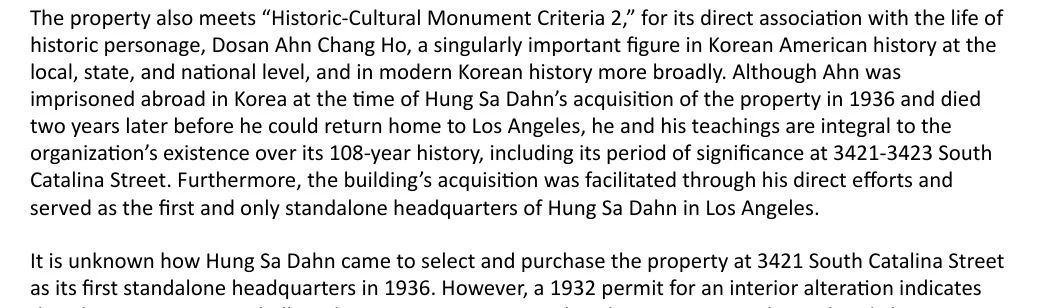
That 1936 date is the center of the file. Page 15, the statement of significance, uses it to argue that the property meets the City’s second criterion, direct association with the life of historic personage, Dosan Ahn Chang Ho
. It admits that Although Ahn was imprisoned abroad in Korea at the time of Hung Sa Dahn’s acquisition of the property in 1936
, and then says the purchase was his work, in the words above. The same date opens the period of significance, 1936 to 1978 (p. 15).
The application, pp. 15 and 21
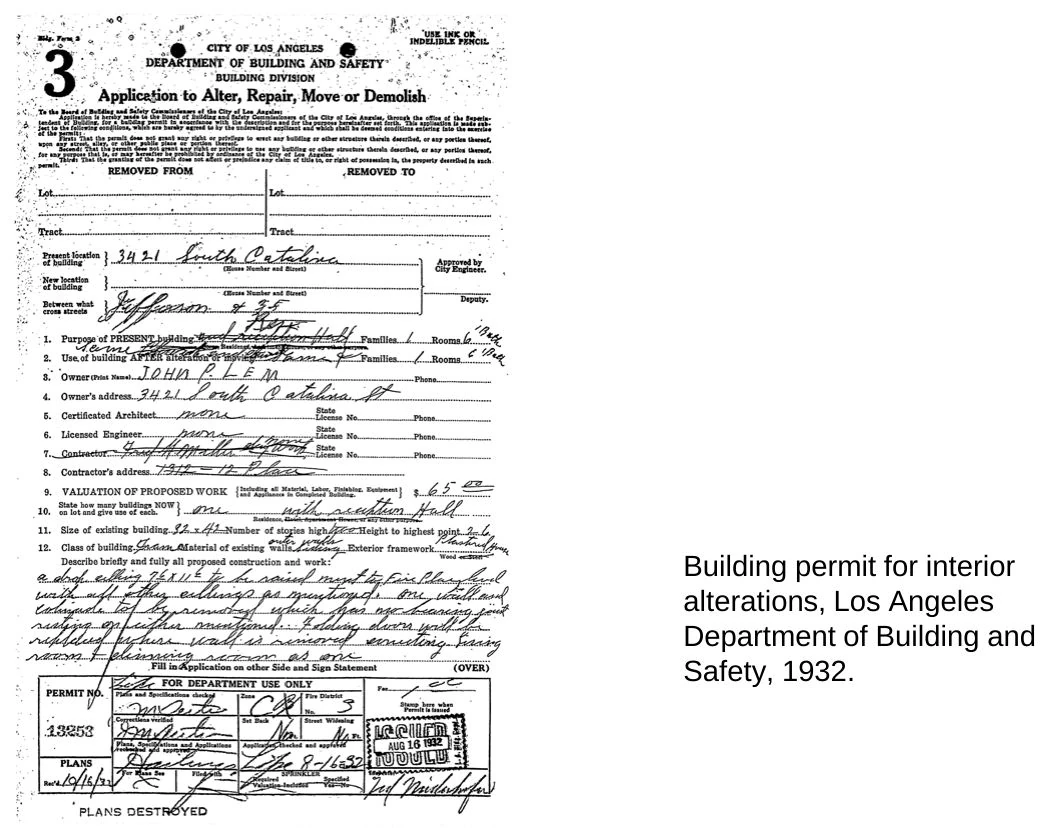
The permit attached to the file, p. 63, 16 August 1932
The 1936 sentence has no footnote. Neither does anything else on pages 3, 4 or 15 about 1936, and the 1936 sentence on page 21 has none. The date appears ten times in the file, on pages 3, 4, 15, 21 and 22. Pages 3 to 5 carry no footnotes at all, and neither does page 15, where the date appears six times.
On page 21 the footnote after the 1936 sentence, 37, is on the sentence that follows it and cites the 1932 permit. The one 1936 with a footnote is on page 22, where Choon Har Kim appears to have resided at the subject property beginning in 1936
, sourced in footnote 40 to page 1071 of the Hung Sa Dahn’s 2013 book.
That is a resident, not a purchase. The file attaches no deed and no record of a sale in 1936. The parcel report (p. 87) lists six deed reference numbers, which the application does not discuss. The earliest document in the file that names the Hung Sa Dahn as owner is the 1958 permit (p. 64).
The nearest source.
The application gives no footnote for the 1936 date on pages 15 or 21. It says that Much of the following information is taken from SurveyLA’s Korean American Historic Context Statement
(p. 16). SurveyLA places the Young Korean Academy at 3421 South Catalina by 1936
, with a city directory as the source for that sentence (survey p. 25, footnote 74: Los Angeles City Directory 1936, 1995.
). The survey does not describe a purchase.
Dosan in 1936.
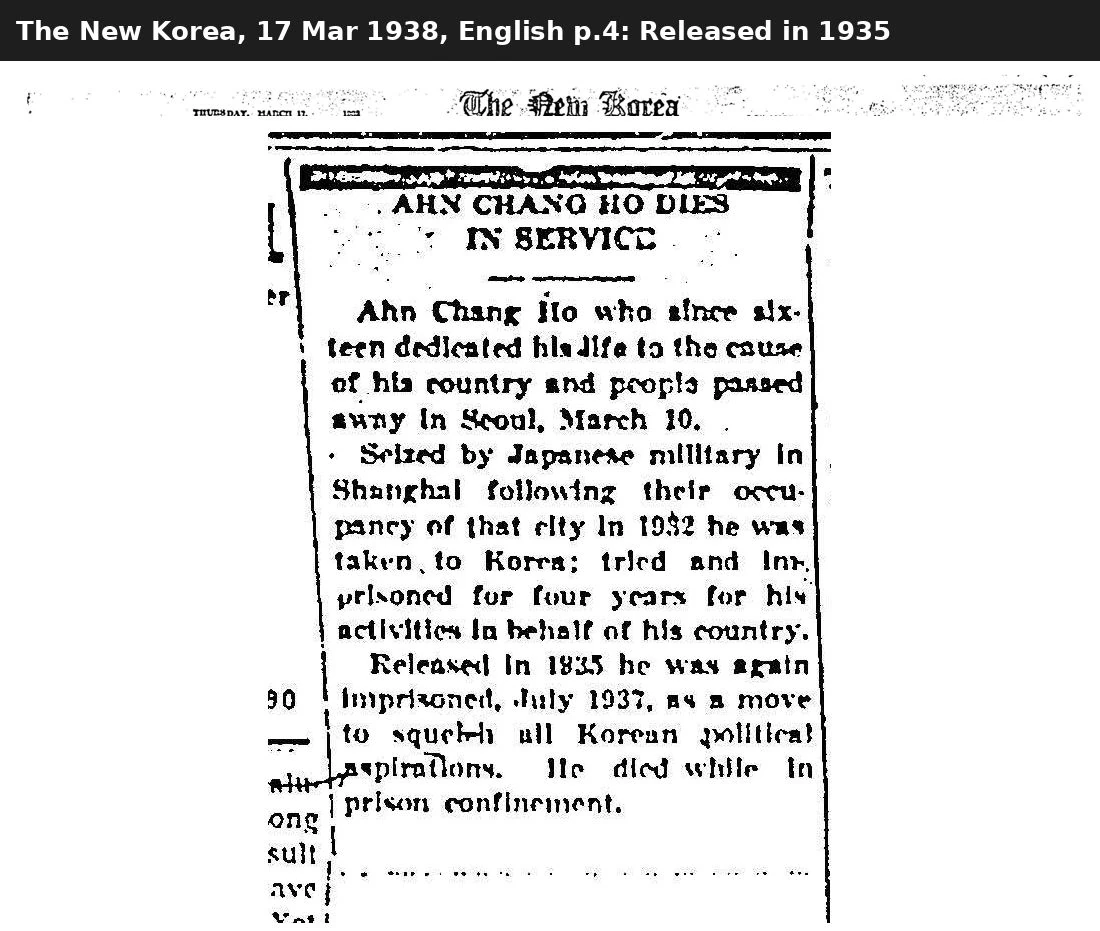
The New Korea of 17 March 1938 says he was seized in Shanghai in 1932 and that Released in 1935 he was again imprisoned, July 1937
. Flip Ahn Cuddy’s chronology of Dosan’s life, which the Ahn family provided, says he was released from Daejon prison in February 1935 and arrested again on 28 June 1937.
The application’s page 17 lists his arrests as 1927, 1932, and 1937
. So the application’s statement that he was imprisoned at the time of a 1936 acquisition does not match these records. Two other accounts give lengths that do not fit a 1935 release.
The New Korea says he was tried and imprisoned for four years
and, in the next sentence, Released in 1935
. The Los Angeles Times article of 7 October 1992 attached at p. 73 reports Susan Ahn as saying he died in 1938 after six years of imprisonment
.
The chronology the Ahn family provided has a four-year prison term imposed on 19 December 1932 and his release on 10 February 1935. Page 17 says he was unable to physically see Hung Sa Dahn’s acquisition of the property
. Page 21 says It is unknown how Hung Sa Dahn came to select and purchase the property
. Page 15 says the acquisition was facilitated through his direct efforts. The application gives no document for either.
Either date, he was not in Los Angeles.
If the purchase was in 1932, Dosan was seized in Shanghai that year (The New Korea, 17 March 1938; the chronology the Ahn family provided). If it was in 1936, he had been released from Daejon prison in February 1935 and was living in Korea (the chronology). Either way he was in Korea or in Japanese custody, not in Los Angeles. Nothing in the file supports the statement that the purchase was facilitated through his direct efforts
.
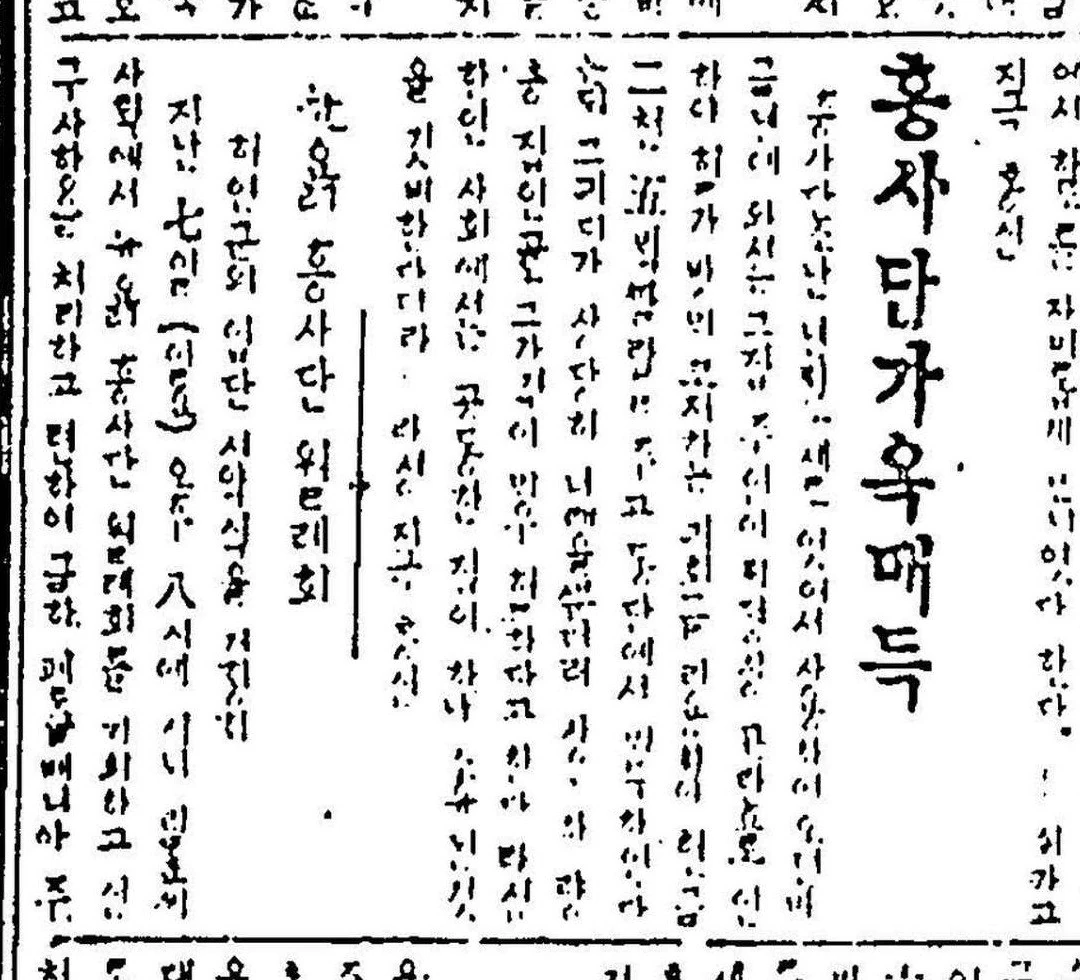
The record, Sinhan Minbo, 25 August 1932, p. 1
The record, The New Korea, 17 March 1938, English page
The newspaper.
The Sinhan Minbo is the Korean-language paper whose English page is headed The New Korea. The application places it at the Korean National Association hall: The Korean-language newspaper The New Korea, with a political bent, was published on site.
(p. 20).
The application never cites an issue of it. Its bibliography lists the USC Korean American Digital Archive, where scans of the paper are held, and its photo captions credit that archive eleven times (pp. 42, 52 to 61). No footnote reaches the newspaper.
The Sinhan Minbo of 25 August 1932 ran a front-page headline reporting that the Hung Sa Dahn acquired a house. The article as scanned does not show a legible street address, so this article does not say which house it was. The masthead address on that issue is the newspaper’s own, not the house’s.
The permit.
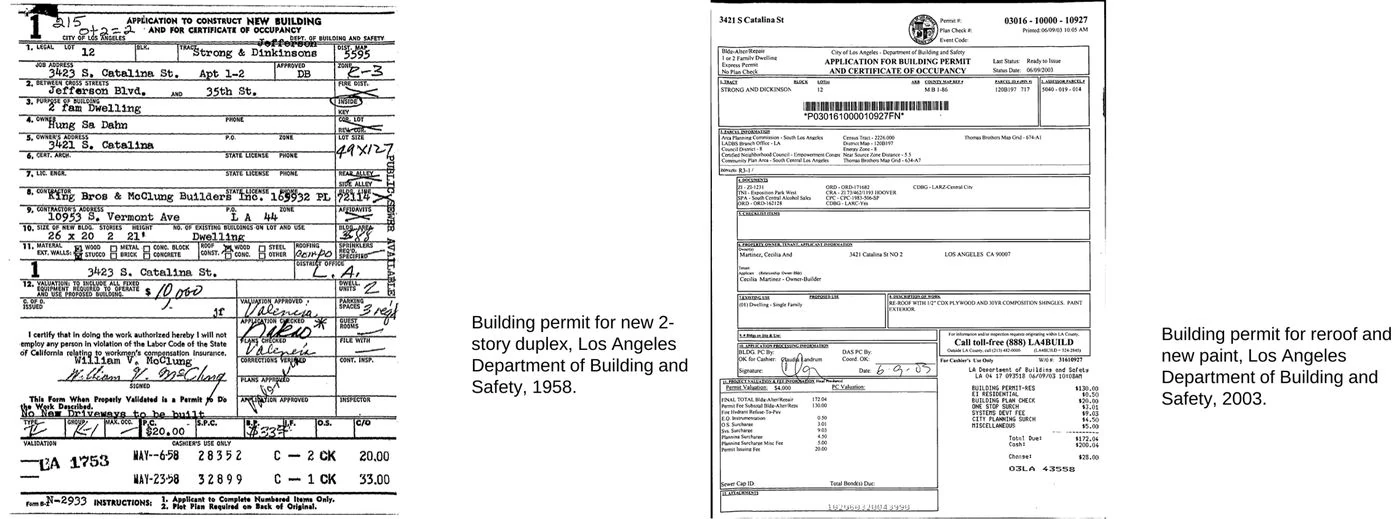
On 16 August 1932 the City issued a building permit for 3421 South Catalina (p. 63; p. 12, fn 2). The form, filled in by hand, gives the permit number as 13253, the owner as John P. Lem and the owner’s address as 3421 South Catalina. The application attaches the permit and cites it twice (pp. 12, 21).
It never names him. The name Lem appears nowhere in the typed text of the 91 pages, only on the scanned permit. The permit names Lem as owner and gives 3421 South Catalina as his address. The application reads the same permit as evidence of a reception hall: a 1932 permit for an interior alteration indicates that there is a reception hall on the property
(p. 21).
The application itself discusses the Alien Land Law on page 22, one of many U.S. alien land laws designed to effectively exclude Asian and other immigrants on the basis of race by preventing individuals ineligible for citizenship from being able to purchase, own, or lease property
(p. 22).
Whether Lem held title for the Hung Sa Dahn is not established by any document in the file. The application does not say who held the lot at any time before the 1958 permit, and a 1932 record predates 1936 in any case.
John Cha’s letter.
The final packet adds a letter dated 8 October 2021 from John Cha (final pp. 61, 62), who writes that he has written about Korean American history, including Dosan Ahn Chang-Ho and his daughter, Susan Ahn Cuddy
(final p. 61) and that he was retained by the owner of 3421-3423 S. Catalina Street
(final p. 61).
It says that the Hung Sa Dahn, after operating in the Bunker Hill area, moved to 3421 Catalina Street in 1932
(final p. 62). That is a different year from the 1936 in both versions of the City’s report. In the passage quoted the letter names no document for the date and does not name Lem. John Cha is a different person from Dr. Marn Cha, whose memoir is attached to the application.
What it means.
The application asks the reader to accept a purchase in 1936 with no document. The one primary property record attached to the file for the early 1930s is a 1932 permit naming John P. Lem as owner, a name the application does not mention; whether he held title for the Hung Sa Dahn is not established by any document in the file.
A Korean newspaper headline of 25 August 1932 reports a Hung Sa Dahn house acquisition but no address is legible in our scan, so it is a lead not yet confirmed. Even a 1932 purchase would be six years after Dosan left Los Angeles for the last time.
A letter that names 1932.
Edward T. Chang, whose article the application cites at p. 17, fn 9 (listed there as Edward Taehan Chang), wrote to the Cultural Heritage Commission in a letter dated 2 November 2021. It says the Korean newspaper the Sinhan Minbo (August 25, 1932) reported that the Heungsadan purchased its headquarters building the Los Angeles and this was the first time in history this occurred
, and that events were held at the building after it was purchased in 1932
.
On the housewarming it says A housewarming party was held on October 2, 1932 at 8 p.m. according to a Sinhan Minbo article published on September 29, 1932 article.
We have not seen that September article. The letter does not mention the 1932 permit or John P. Lem.
It also says Flip Cuddy has a long track record of trying to oppose historic designations of Dosan related sites
. It is not part of the City’s packet. A copy reached Flip Ahn Cuddy the evening it was dated: Tom Byun forwarded it to him at 7 pm on 2 November 2021, saying someone had sent it to him.
Sources: City file pp. 3, 4, 5, 12, 15, 16, 17, 20, 21, 22, 24, 63, 64, 73, 87; final packet pp. 61, 62; SurveyLA, PDF p. 25; Sinhan Minbo, 25 August 1932, p. 1; The New Korea, 17 March 1938; Edward T. Chang, letter to the Cultural Heritage Commission, 2 November 2021 (copy forwarded to Flip Ahn Cuddy by Tom Byun, 2 November 2021; not in the City packet).
Exhibit 2 | Application, pp. 17, 47
A City Hall memorial that was held in a church
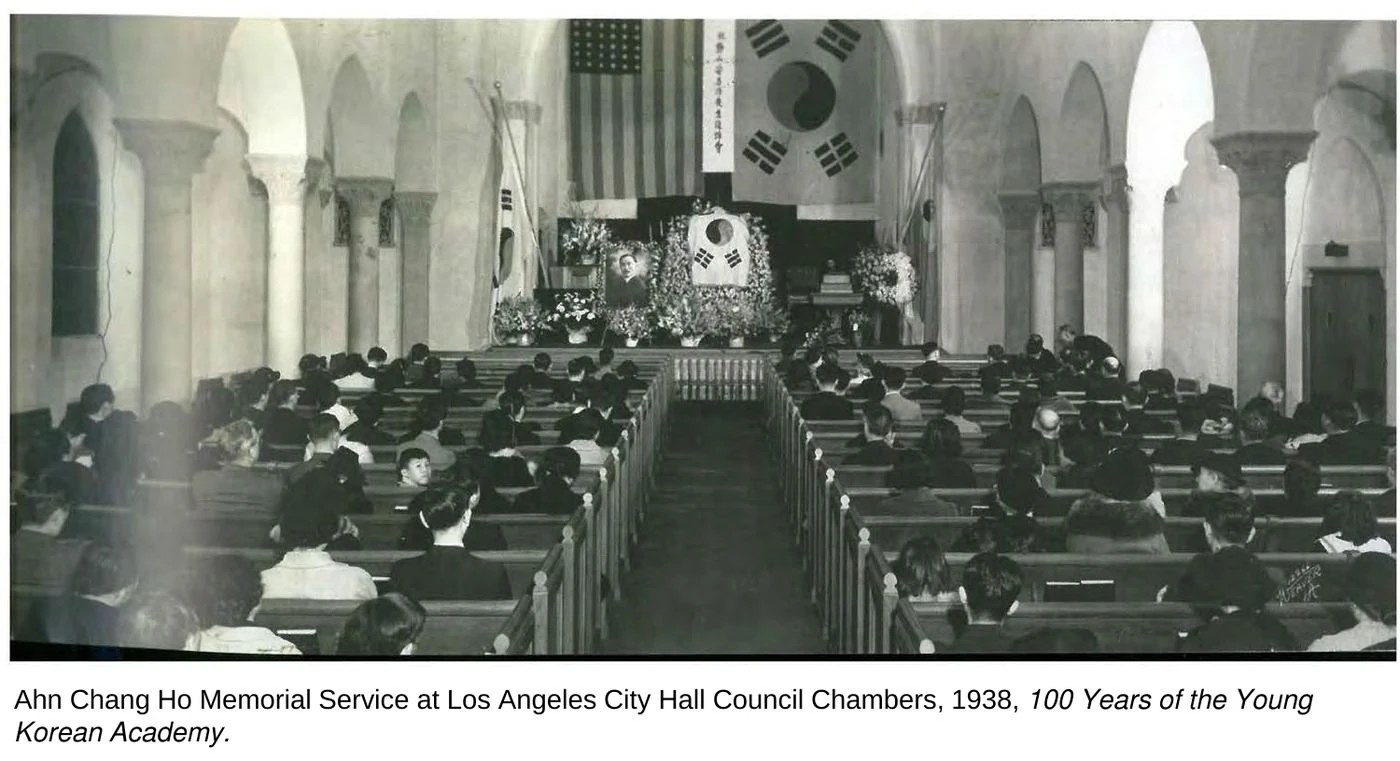
a public memorial service for Ahn was held in the Los Angeles City Hall Council Chambers on March 20, 1938.
Application, p. 17. The only source given, footnote 12, is the Hung Sa Dahn’s own 2013 book, 100 Years of the Young Korean Academy, page 021.
Ahn Chang Ho Memorial Service at Los Angeles City Hall Council Chambers, 1938, 100 Years of the Young Korean Academy.
Application, p. 47, photo caption
Dosan died in Seoul on 10 March 1938. His widow and children were living in a house at McClintock Avenue and 34th Street near the University of Southern California, where Helen Ahn had moved them in 1937 (p. 17). The Korean National Association had moved its headquarters from San Francisco to Los Angeles the same year (p. 19).
The application’s page 17 puts the memorial in a municipal room, and page 47 prints a photograph under the same claim. One source stands behind both. Footnote 12 on page 17 is the Hung Sa Dahn’s own 2013 book, page 021, and the caption on page 47 credits the same book. Footnote 11, in the same sentence, cites the Los Angeles Times report of his death, and that report does not mention a memorial.
The application, p. 47
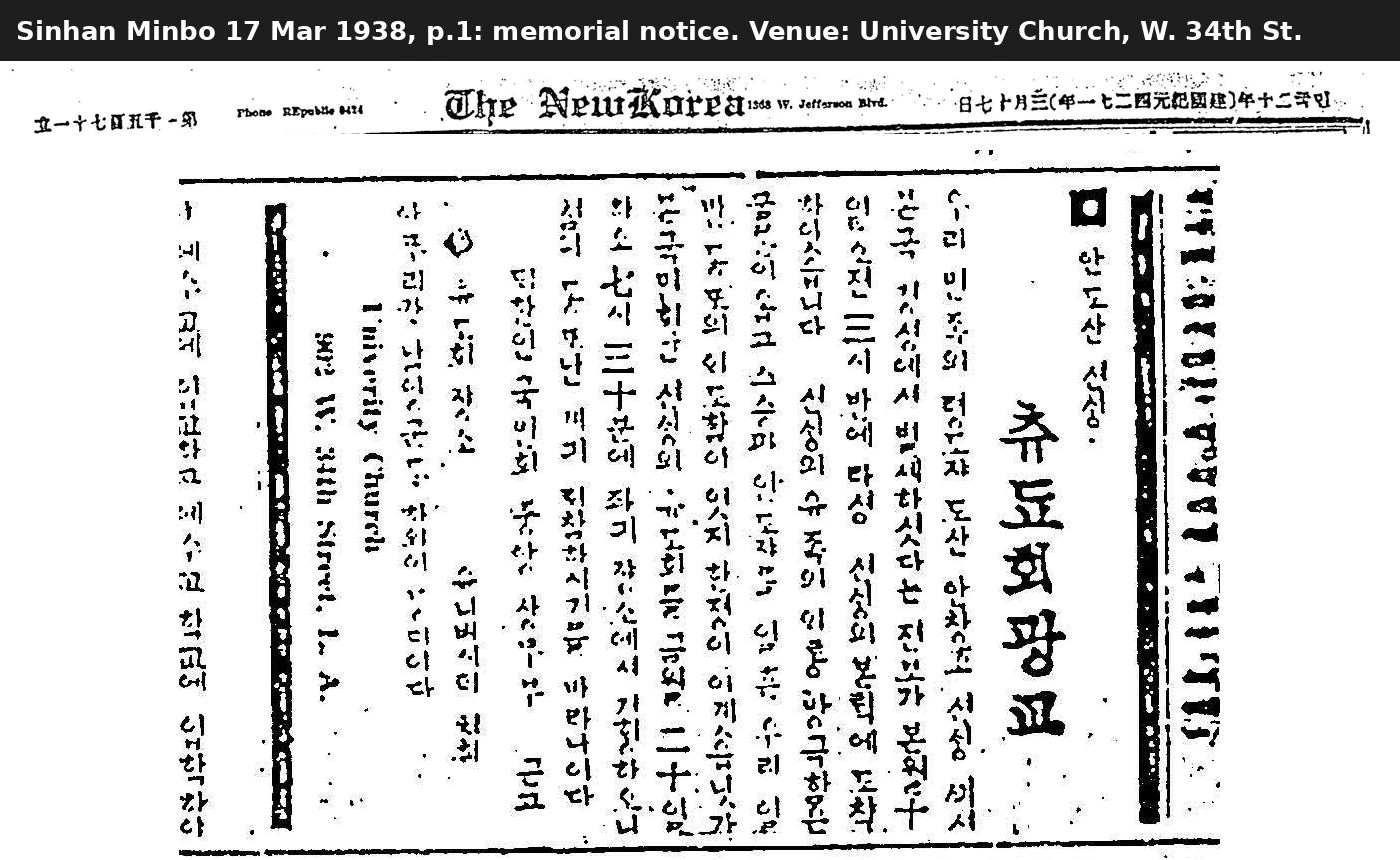
The record, Sinhan Minbo, 17 March 1938, p. 1
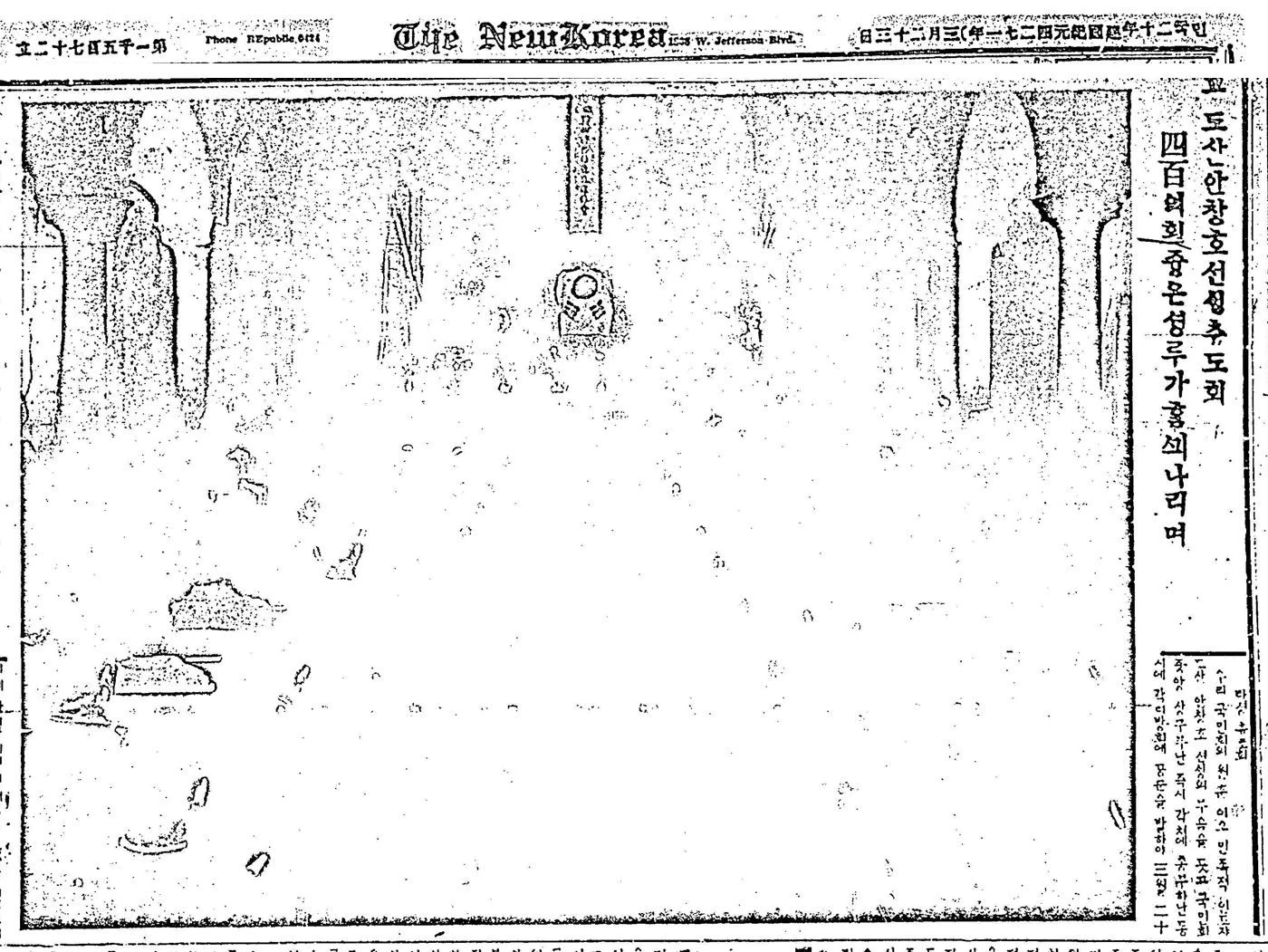
The record, Sinhan Minbo, 24 March 1938, p. 1
The record, The New Korea, 24 March 1938, English page
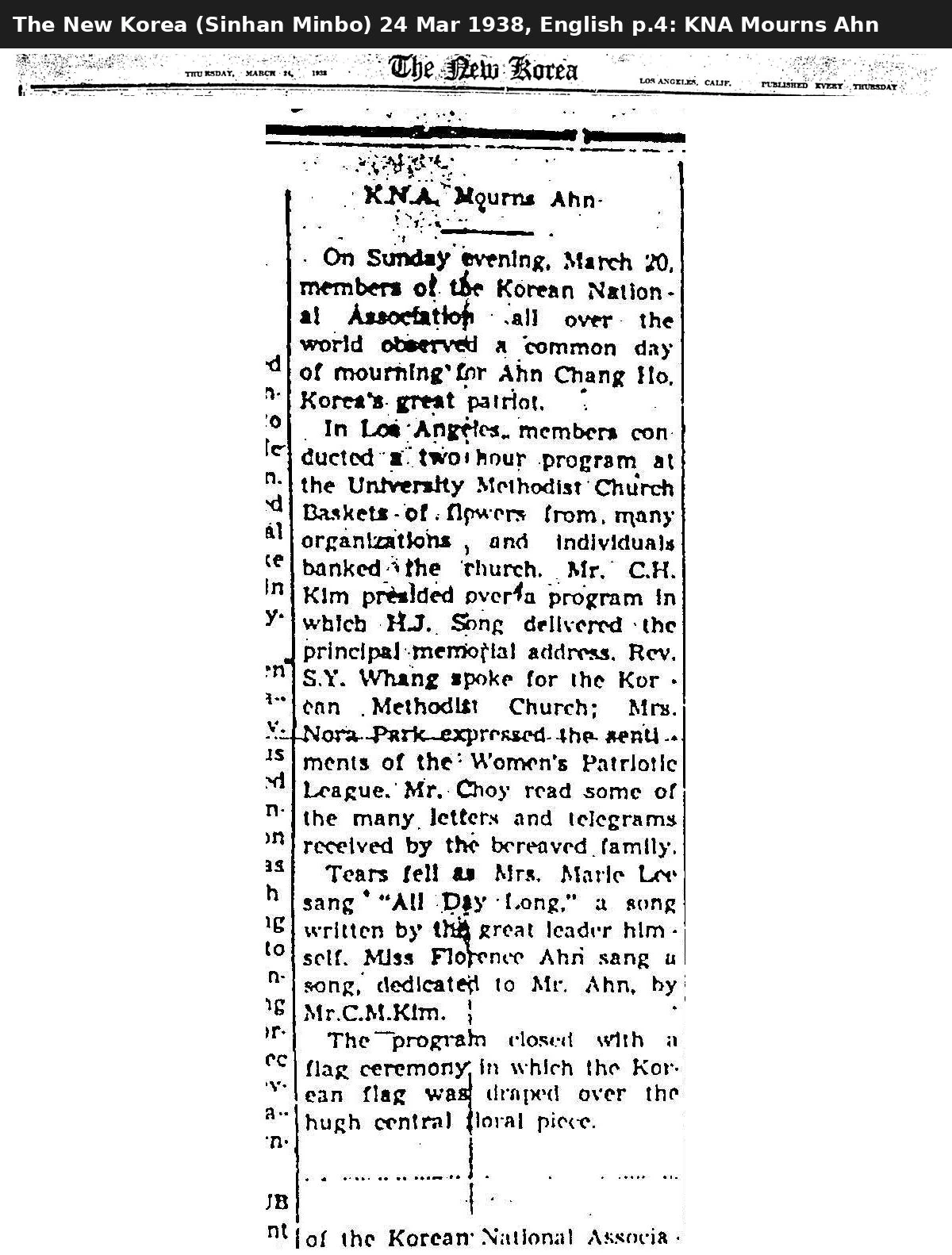
A week after he died the Sinhan Minbo announced the service for Sunday 20 March at University Church. On the front page of its 24 March issue (its English page is dated Thursday 24 March) it printed a photograph of the service. Its English page reported that members conducted a two hour program at the University Methodist Church
. Flip Ahn Cuddy places that church next to the Ahn family house, which the application says USC moved onto its campus in 2004 (pp. 17, 18).
The Sinhan Minbo notice and The New Korea give Sunday 20 March. The place is wrong. The application’s only source for “City Hall” is the Hung Sa Dahn’s own 2013 book. The newspaper the application itself describes as published at the Association hall (p. 20) printed the notice and a photograph of the service; the notice and the English page of the 24 March issue say church.
The application repeats the City Hall claim in text and in a caption, with one book behind both.
Sources: City file pp. 17, 18, 19, 20, 24, 47; Sinhan Minbo, 17 March 1938, p. 1 and 24 March 1938, p. 1; The New Korea, 17 and 24 March 1938; Flip Ahn Cuddy, family statement.
Exhibit 3 | Application, pp. 17, 39
A 1909 caption for children who were not yet born
Philson, Susan, and Soorah at Ahn Residence at 1411 W 4th St., 1909. Shades of L.A. Collection.
Application, p. 39, photo caption
The application has historical photographs beginning on page 37, and pages 39 and 40 are the first to show Dosan’s family. Both are credited to the Shades of L.A. Collection, a Los Angeles Public Library project listed in the application’s bibliography (p. 24). Neither caption names a donor. The application says the Hung Sa Dahn’s headquarters moved with Dosan and his family, so where it puts them in the 1910s matters (p. 21).
The application, p. 39
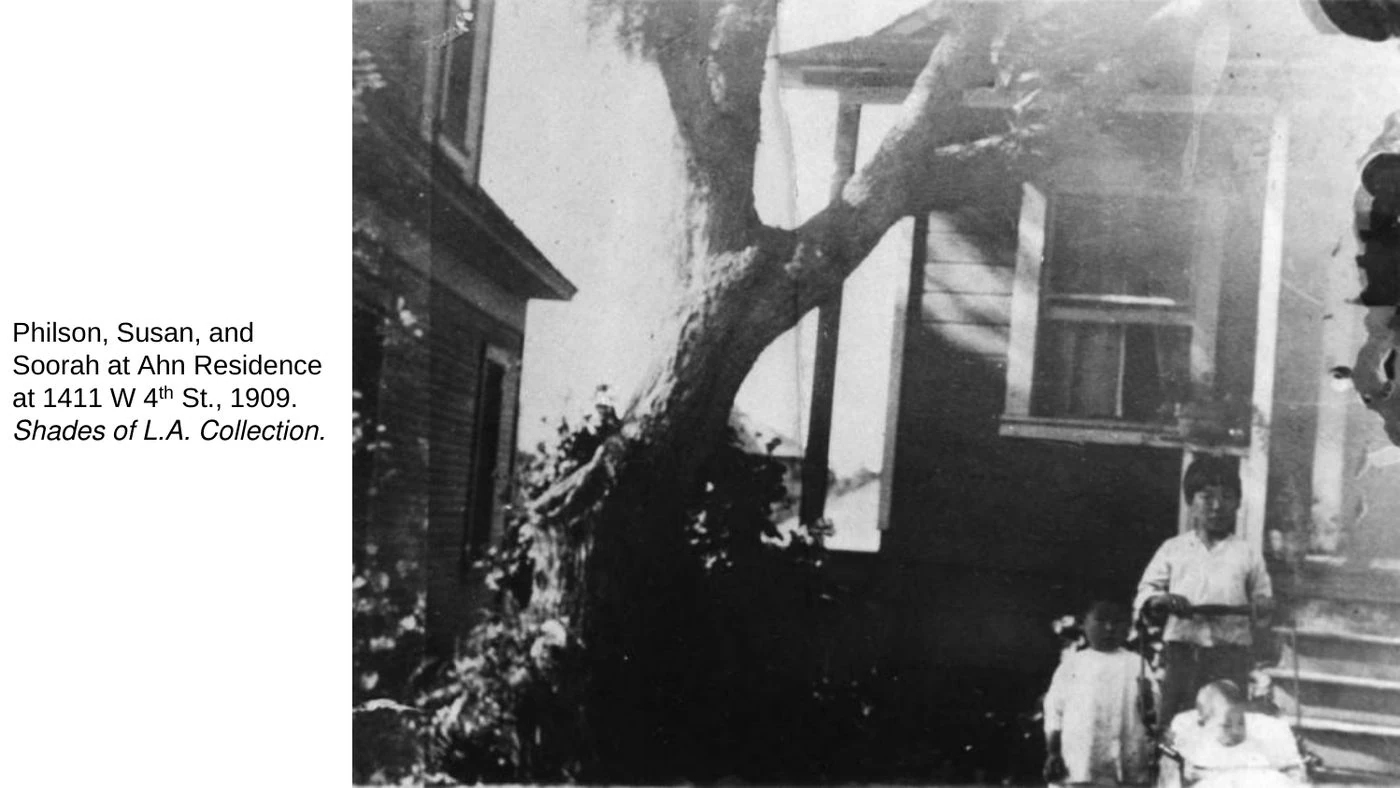
The application again, p. 17

Philson, Susan and Soorah were all born after 1909 (the Ahn family’s chronology). The application’s own page 17 has the family in Los Angeles by 1914 and says that Upon arrival, they lived at 1411 West Fourth Street
. A 1909 photograph at that address cannot be right by the application’s own account. The caption also names Soorah, who was born in 1917 (the Ahn family’s chronology).
Flip Ahn Cuddy identifies the children as Philip, Philson and Susan, his mother, at 1411 West 4th Street in 1915. He says his mother was born in the Fourth Street house. Asked about the 1909 date, he was blunt. The date written on one of the 1411 photos says 1915,
he said. No way it’s 1909. My mom was born January 16, 1915, and lived to be 100. How many of her birthdays were based on 1915? All of them! My mom knew her birthday and so did I.
The caption is wrong about the year and, Flip Ahn Cuddy says, about who is in the picture. It moves the family to Fourth Street five years before the date the application gives for the family’s arrival in Los Angeles. The caption credits the Shades of L.A. Collection; the application does not say who wrote the caption, and its own page 17 contradicts it.
Sources: City file pp. 17, 24, 37, 39; Flip Ahn Cuddy, family statement.
Exhibit 4 | City file, p. 40
Helen Ahn’s photograph, the family says, shows another family
Helen Ahn with children at 1411 W 4th St.,1917, Shades of L.A. Collection.
Application, p. 40, photo caption
Helen Ahn (Lee Hye Ryon) emigrated to San Francisco with Dosan in 1902 (p. 4) and moved with their five children to a house near USC in 1937 (p. 17). Page 40 is the only photograph in the application captioned as Helen Ahn. It follows the page 39 photograph and carries the same library credit. The application’s own text says the family was at 106 North Figueroa Street by 1917 (pp. 17, 21): first at 1411 West 4th Street, then by 1917 at 106 North Figueroa Street
.
The application, p. 40
A woman seated with two girls and a toddler.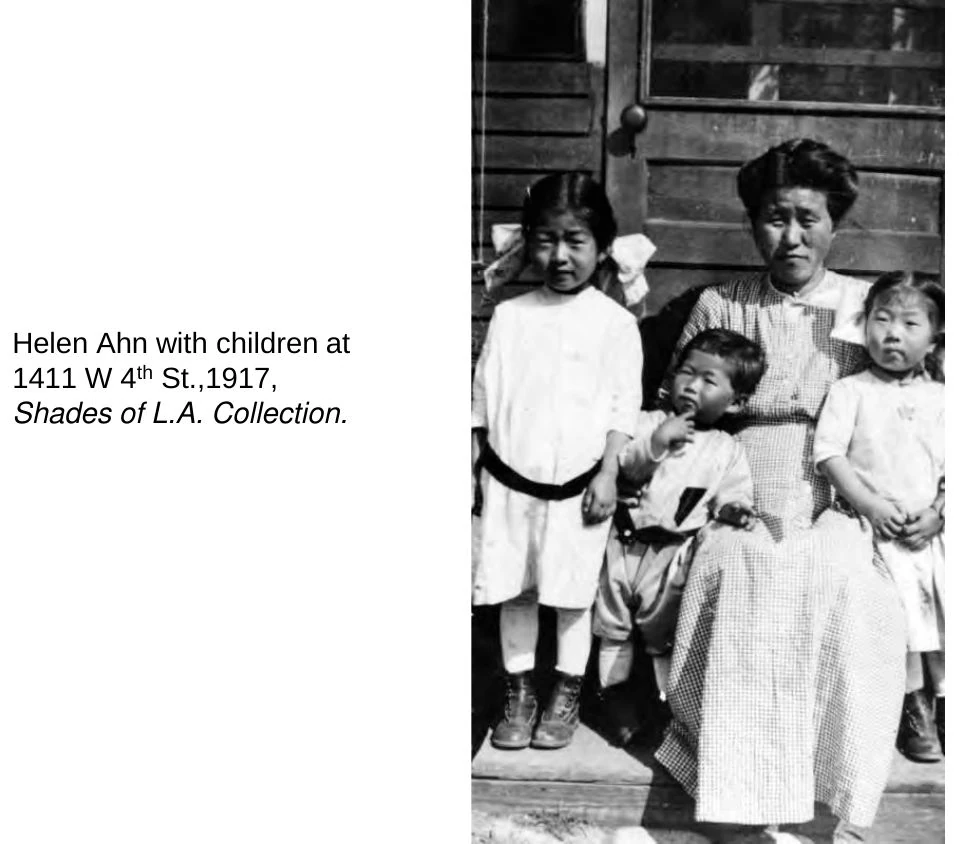
According to the Ahn family (Flip Ahn Cuddy), the photograph shows another Korean family, and not Helen Ahn. He says it was taken in Riverside and that the children are not the Ahn children. He told the City the same on 13 September 2021, in his reply to its email: not Helen, not in Los Angeles and not any Ahn children.
He identifies the children as Dollie Kim and Powell and Sadie Lee, a brother and sister, and says their mother, Lee (Kim) Song Nae (Emma), is not in the photograph. He does not name the woman.
By the chronology’s dates, the Ahn children in 1917 were Philip, Philson (5 July 1912), Susan (16 January 1915) and, from 27 May, Soorah. Flip Ahn Cuddy says Soorah was born in the Figueroa house. His 1996 essay on Philip Ahn gives Philip’s birth as March 29, 1905.
Page 40 is the one picture in the application meant to show Dosan’s wife, as its caption reads. Flip Ahn Cuddy says it is a picture of another Korean family.
Sources: City file pp. 4, 17, 21, 40; Flip Ahn Cuddy, email to Ken Bernstein, 13 September 2021, 10:51 pm; Flip Ahn Cuddy, family statement.
Exhibit 5 | Application, pp. 16, 17, 19
Three buildings, none tied to him before he left
one of only three extant buildings in Los Angeles that are directly associated with Ahn
Application, p. 16. The other two named are the Korean Independence Memorial Building (HCM-548) and the Dosan Ahn Chang Ho Family Home (HCM-1059).
A building can be a Historic-Cultural Monument under the City’s second criterion if it Is associated with the lives of historic personages important to national, state, city, or local history
(p. 5). The application makes its case under that criterion with a count: three buildings in Los Angeles tie directly to Dosan, and this is one of them.
Page 16 ends the paragraph by saying All other physical structures associated with him have been lost
. Page 21 says of the two places the Ahns and the Hung Sa Dahn used in Los Angeles in his time, 1411 West 4th Street and 106 North Figueroa Street: Neither of these buildings are extant.
The application, p. 16

The application again, p. 19

Page 17 says he departed his home in Los Angeles for the last time in 1926
. On the application’s own dates, the KNA hall was built in 1938 (p. 19), the Family Home was occupied in 1937 (p. 17), and the Catalina house was acquired in 1936 (p. 15). All three are after the 1926 departure the application gives. The permit attached to the file is dated 1932 (p. 63); 1932 is also after 1926. Page 16 itself only goes as far as directly associated with Ahn
and during his lifetime
.
The Korean Independence Memorial Building (HCM-548) is described on p. 16 as the Korean National Association’s headquarters. Page 19 says the Association built a simple structure at 1368 West Jefferson Boulevard in 1938
, after moving its headquarters to Los Angeles the year before.
For that hall, footnote 28 on p. 20 reads Koreatown Rotary Club, “Korean Independence Memorial Building,” City of Los Angeles Historic-Cultural Monument Application, December 5, 1990.
The Family Home (HCM-1059) is where Helen Ahn moved the children in 1937
(p. 17).
The third building is the Catalina house. The application dates its acquisition to 1936 (p. 15), and the 1932 permit attached to the file names John P. Lem as its owner (p. 63).
The Commission’s adopted Findings separately say, on the criterion tied to Dosan himself, that the subject property is not directly associated with the productive period of his life
.
Sources: City file pp. 4, 5, 15, 16, 17, 18, 19, 20, 21, 63; Commission Findings, p. 2.
Exhibit 6 | Application, pp. 17, 70
A headline cited without its last word
The Los Angeles Times published an article entitled “Angeleno Dies in Seoul,”
Application, p. 17. Footnote 11: Los Angeles Times, “Angeleno Dies in Seoul,” 13 March 1938, accessed 14 June 2021.
The Los Angeles Times of 13 March 1938 carried the paper’s report of Dosan’s death three days after it happened. It is the only 1938 newspaper article in the file. The file sets it at page 70, under the divider “Newspaper Articles” (p. 69), in a ProQuest printout, with the caption Los Angeles Times, 1938
.
The application, p. 17
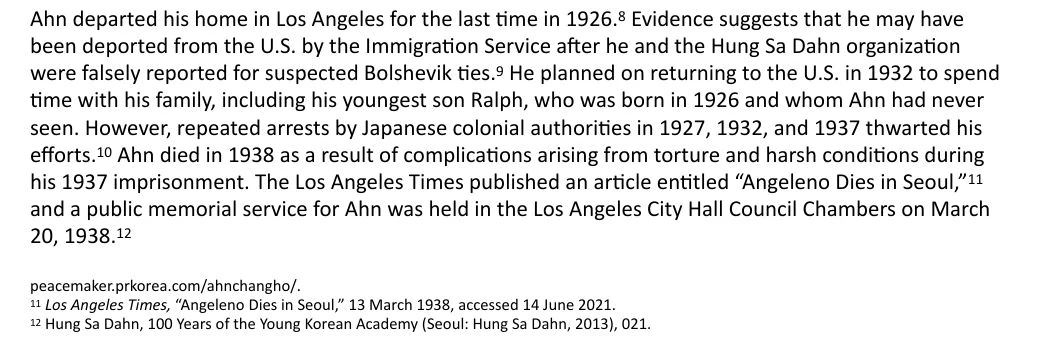
The record, Los Angeles Times, 13 March 1938, application p. 70
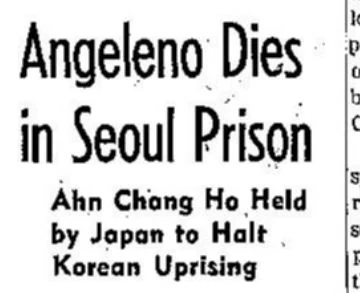
The article the file attaches at page 70, of the same date, is headed “Angeleno Dies in Seoul Prison.” The application’s text and footnote quote the title as “Angeleno Dies in Seoul.” Footnote 11 gives no page.
The same clipping says his last visit to his family in Los Angeles was in 1925. The family’s chronology and both City pages (pp. 4, 17) give 1926. The article says the news reached Los Angeles by cable to the Korean National Association. It does not name the Hung Sa Dahn and does not mention a memorial service.
The application gives the title one way in its text and again in its footnote, while the page it attaches reads differently. This article does not rely on either wording for where he died.
Sources: City file pp. 4, 17, 69, 70; Los Angeles Times, 13 March 1938.
What City staff concluded
The final staff report is final pp. 2 to 8 of the packet for the 4 November 2021 hearing. This is the staff recommendation for that hearing. The packet holds the recommendation and the papers before the Commission; the packet does not record what the Commission decided; the Commission’s letter and the Council papers, below, do.
The report asks the Commission to Declare the subject property an Historic-Cultural Monument
(final p. 3). The report recommends designation on the first criterion only: the property exemplifies significant contributions to the broad cultural, economic or social history of the nation, state, city or community
for its association with the Hung Sa Dahn (final p. 4). Its discussion says The subject property meets one of the Cultural Heritage Ordinance criteria
(final p. 6).
The application argues two criteria: the first, and the second, the property’s association with Dosan (July p. 15; final p. 95). The final report accepts the first. On the second it says staff are unable to make this finding
(final p. 7). It gives the reason in the same paragraph: the subject property is not directly associated with the productive period of his life and therefore does not meet this criterion
. It also says Ahn rises to the level of an historic personage
.
The City’s final report, final p. 7
The paragraph on the Dosan criterion (report page 6 of 7).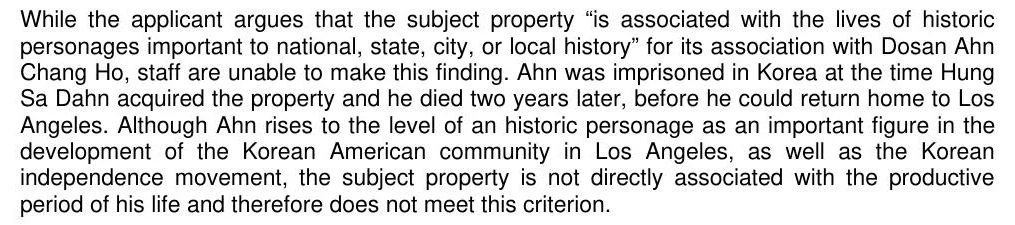
The same paragraph repeats the application’s premise. It says Ahn was imprisoned in Korea at the time Hung Sa Dahn acquired the property
(final p. 7), and an earlier page of the report keeps its purchase in 1936
(final p. 6). The report gives no footnote or deed for the 1936 purchase. Exhibit 1 sets beside it The New Korea of 17 March 1938, which says Released in 1935 he was again imprisoned, July 1937
.
The final report gives a different end date for the headquarters than the July report. The July report (p. 3) says the headquarters ran from 1936 to 1978. The final report says From 1936 to 1948
(final p. 4), and its own page 7 says Three years following Korea’s independence from Japan in 1945, the global headquarters for Hung Sa Dahn relocated to Seoul, South Korea.
(final p. 7). The points that remain are set out in The file against itself.
Sources: final packet pp. 3, 4, 6, 7, 95; City file pp. 3, 15; The New Korea, 17 March 1938.
The City was told
The final packet contains an email from Philip “Flip” Ahn Cuddy, sent Monday, 13 September 2021, 12:22 PM PDT, subject “3421 Catalina YKA House HCM Application” (final pp. 68 to 71). It is printed as a forwarded message, addressed to staff of the Office of Historic Resources and copied to others.
In the packet it is Exhibit C to the letter of the owner’s lawyers, dated 12 October 2021: the packet lists that correspondence as Correspondence from Property Owner’s Representative, Received October 12, 2021
(final p. 3), and the lawyers’ letter cites the email with (See Exhibit C.)
(final p. 56). It is not a document the City filed itself.
The City’s final packet, final p. 68 (addresses covered)
First page of the email, cropped. The From, To and Cc lines are covered by a solid block, as is the rest of the text except the Sent and Subject lines and the sentence on the City Hall caption.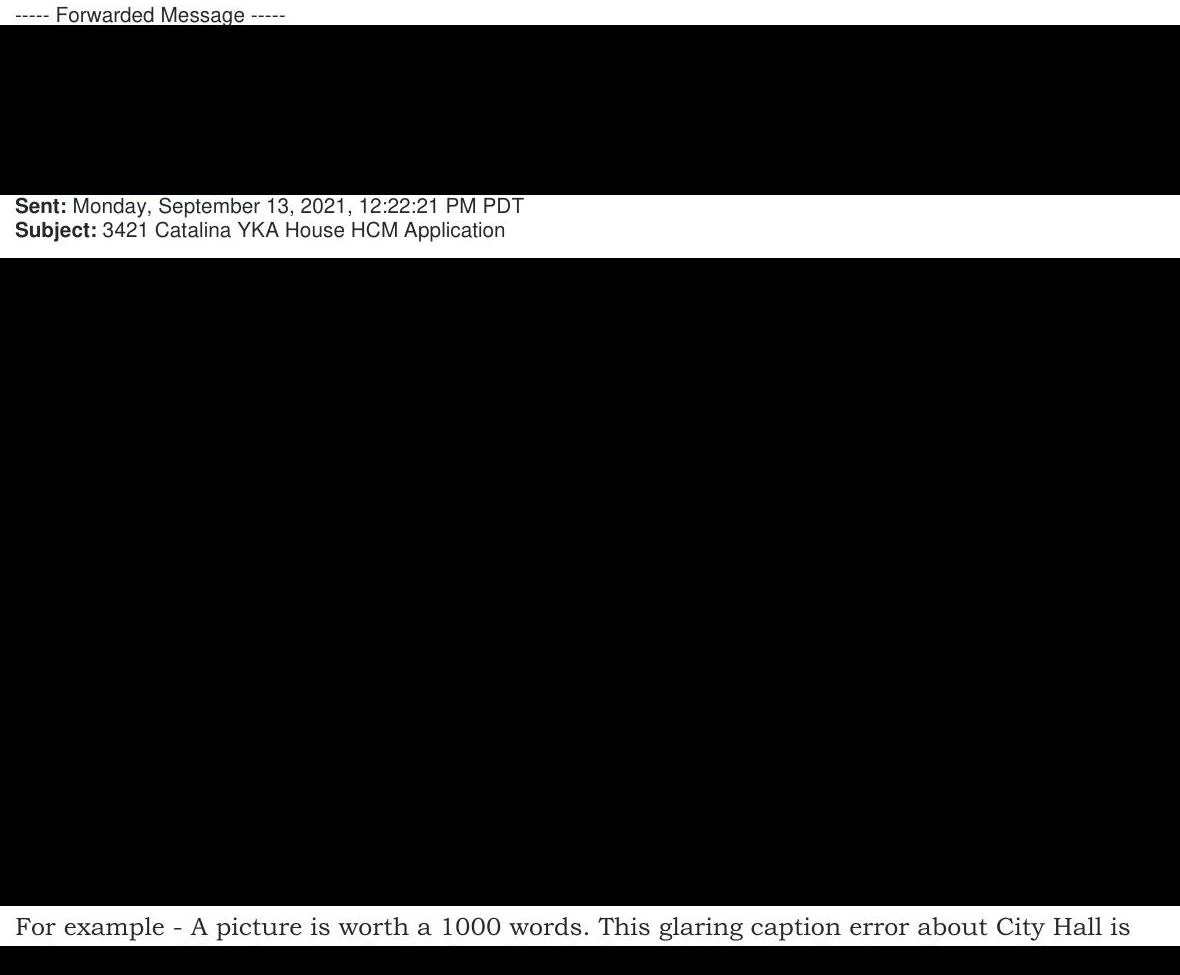
The email flags one caption. Its words are This glaring caption error about City Hall
(final p. 68). Final p. 69 is a label page headed From the Application CHC-2021-5125-HCM
(final p. 69). Final p. 70 is the memorial photograph with its caption highlighted and the note Does this look familiar? You approved the Church on USC Campus that is next to the Ahn Family house as City Hall
(final p. 70).
That is the memorial caption of Exhibit 2. Final p. 71 is a photograph of another chamber, with no caption. The email does not mention the captions on pp. 39 and 40, or the 1936 date.
The application in the City’s final packet, final p. 127
The p. 47 caption as it appears in the application re-attached to the packet for the 4 November hearing (final p. 127).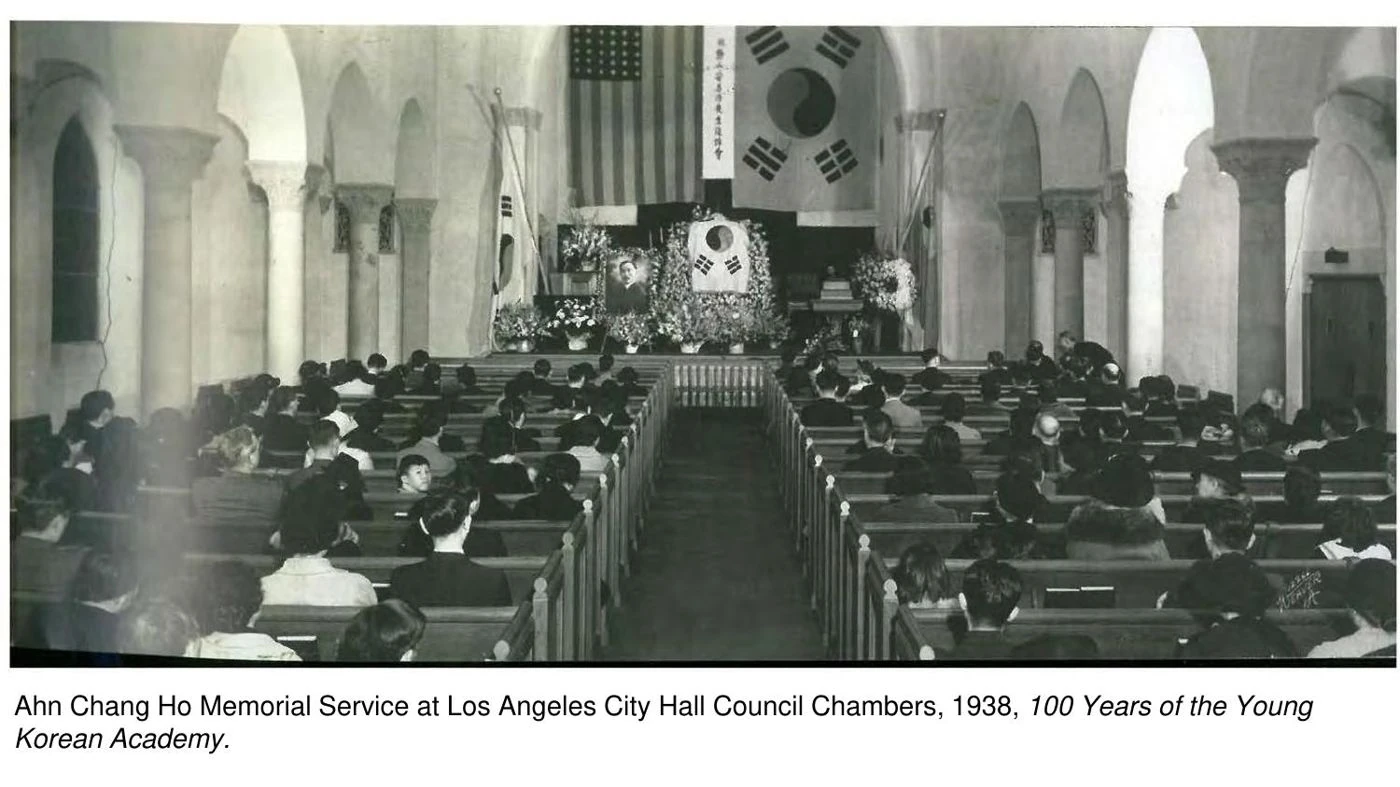
The final staff report (final pp. 2 to 8) does not repeat the City Hall claim. The City’s reply to the email is not part of the packet; Flip Ahn Cuddy’s copy is described below. The application in the packet is the one the Director of Planning found complete on 22 June 2021 (final p. 8), unchanged, so it carries what it carried in July.
Final p. 127, which is the application’s p. 47, reads Ahn Chang Ho Memorial Service at Los Angeles City Hall Council Chambers, 1938, 100 Years of the Young Korean Academy.
The application’s text on final p. 97 says a memorial service was held in the Los Angeles City Hall Council Chambers
, as on the July p. 17.
The p. 39 caption is on final p. 119 and reads Philson, Susan, and Soorah at Ahn Residence at 1411 W 4th St., 1909. Shades of L.A. Collection.
The p. 40 photograph is on final p. 120. The embedded images of pp. 39, 40 and 47 are byte-for-byte the same as those on final pp. 119, 120 and 127.
The 1936 date is in the final report (final pp. 4, 6) and in the application. The lawyers’ letter cites the email in the part of its argument that opposes the nomination (final p. 56).
The City’s reply.
Ken Bernstein of the Office of Historic Resources replied to Flip the same evening, Monday, 13 September 2021, at 6:09 pm (Ken Bernstein, email to Flip Ahn Cuddy, 13 September 2021). He wrote that what would be most helpful was more specific written information, with citations
.
He asked Flip to refrain from editorializing on the qualifications or motivations of other community participants
and to focus on factual information that speaks directly to whether the property meets the criteria of the Cultural Heritage Ordinance
.
He added: Once we receive your supplemental information, I will make sure that our staff reviews these points carefully
, since we want all nominations proceeding to the Cultural Heritage Commission to be as accurate as possible
. The reply is not part of the packet; we have it from Flip Ahn Cuddy’s own email records. The application in the final packet still carries the City Hall caption (final p. 127).
The same set of attachments also contains a letter from Philip Cuddy and Christine Cuddy, Exhibit B, which the lawyers’ letter dates 9 September 2021 (final pp. 56, 64 to 66). It states that it is submitted on our behalf in deep-rooted opposition to the proposed Historic Cultural Monument (HCM) nomination
(final p. 65), and says We have volunteered, and the owners have accepted, our offer to work together to design and install such recognition.
(final p. 66).
The owner’s lawyers describe the same offer in a section whose heading says the owner has volunteered to honor the history of Dosan and the Hungsadan with a plaque and tribute garden
, with a conceptual design attached as Exhibit G (final pp. 58, 79, 80): Philip Cuddy, the grandson of Dosan, has volunteered to assist the owner in the design of the garden, and the substance of the plaque.
(final p. 58).
Sources: final packet pp. 3, 4, 6, 8, 56, 58, 64 to 66, 68 to 71, 79, 80, 97, 119, 120, 127; City file pp. 39, 40, 47; Ken Bernstein, email to Flip Ahn Cuddy, 13 September 2021 (Flip Ahn Cuddy’s email records; not in the City packet).
What happened next
On 4 November 2021 the Cultural Heritage Commission took the actions in its letter to include Hung Sa Dahn in the list of Historic-Cultural Monuments, subject to adoption by the City Council. Its letter to the Council, dated 16 November 2021, records the vote as 3 to 1: moved by Kennard, seconded by Milofsky, Barron aye, Kanner nay, Buelna absent. The Commission also adopted a set of Findings (Council file 21-1349).
The Findings rest on one criterion only. They state: The subject property meets one of the Cultural Heritage Ordinance criteria: it “exemplifies significant contributions to the broad cultural, economic or social history of the nation, state, city or community” for its association with the Korean American patriotic organization, Hung Sa Dahn, for which the property served as its first permanent headquarters, and for its role as an important social and cultural hub for the Los Angeles Korean American community.
They decline the criterion tied to Dosan Ahn Chang Ho: staff are unable to make this finding
, and the property is not directly associated with the productive period of his life
.
The same Findings repeat the application’s claims. They say the house was the organization’s first permanent headquarters and that its purchase in 1936
marked the end of a nomadic period. They also say Ahn was imprisoned in Korea at the time Hung Sa Dahn acquired the property
. These are the same statements this article examines above.
On 21 February 2023 the Planning and Land Use Management (PLUM) Committee recommended approving the designation. Its recommendation 3 reads ADOPT the FINDINGS of the Cultural Heritage Commission (CHC) as the Findings of Council.
The vote as listed: Harris-Dawson, Rodriguez, Yaroslavsky and Hutt yes; Lee absent.
The PLUM report says the Committee recommended to approve the inclusion of Hung Sa Dahn in the list of Historic-Cultural Monuments
.
On 28 February 2023 the City Council adopted the PLUM report; its Council Action reads ADOPTED
. The effect was that the Commission and then the Council approved the inclusion of Hung Sa Dahn in the list of Historic-Cultural Monuments. The Official Action lists 11 yes votes, none recorded as no, and 3 members absent: Hutt, Park and Price Jr. So the findings the Council adopted say the house is not directly associated with the productive period of Dosan’s life, and they still carry the 1936 purchase date and the statement that he was imprisoned at the time. The Council voted on the PLUM report as a whole; the papers record no separate vote on any finding.
Documents: Cultural Heritage Commission letter to Council, 16 November 2021; Commission Findings; PLUM Committee report, 21 February 2023; Official Action of the City Council, 28 February 2023; Council file 21-1349.
How the file was built
The file is two documents bound together. Pages 1 to 5 are the Department of City Planning’s recommendation report to the Cultural Heritage Commission. Pages 6 to 91 are the application behind it: the nomination form, the preparers’ text, photographs, permits, maps, clippings, a memoir and a printed parcel report.
Page 1 names the applicant, Michelle Magalong of Asian & Pacific Islander Americans in Historic Preservation, and two preparers, Rosalind Sagara of the Los Angeles Conservancy and Katherine Kim. Page 11 marks Sagara as the primary contact. Page 2 lists four staff of the Office of Historic Resources as signatories: Ken Bernstein, Shannon Ryan, Lambert M. Giessinger and Melissa Jones.
The July report does not test the application. Its recommendation is that the Commission take the property under consideration because the application and photographs suggest the submittal warrants further investigation
. Its findings rest on the application: Based on the facts set forth in the summary and application
, it says, the property may be significant enough to warrant further investigation as a potential Historic-Cultural Monument
.
The history on pages 3 and 4 closely follows the application’s history, with no footnotes. The final report is the next stage of the same case (see What City staff concluded).
Pages 12 to 23 are the preparers’ own text: the property description (pp. 12 to 14) and the statement of significance (pp. 15 to 23). The application says they lacked access to the site four times (pp. 12, 13) and gives no description of the interior. Page 12 says in part why the exterior photographs show so little: show limited visibility due to the presence of a construction fence at the front property line and construction debris in the front yard
.
Page 10 says what the preparers relied on for the spelling of the organization’s name: city directories, building permit records and the organization’s own primary records during the time it occupied the subject property at 3421 South Catalina Street
.
The application does not say which records. No footnote or bibliography entry names a record made by the organization in the years it is said to have held the house. A member newsletter of 1966 is reproduced at page 75, credited to the 2013 book, and no footnote cites it.
There are 45 footnotes. They sit on ten of the twelve pages of the preparers’ text: pages 12, 13 and 16 to 23. Pages 14 and 15 have none, and page 15 is the summary where the 1936 purchase, the imprisonment and the “direct efforts” are stated. Counting the footnotes by what they cite:
- six cite Katherine Kim’s photo book Images of America: Los Angeles’s Koreatown;
- six cite Yoo and Ahn’s centennial history of a Methodist church, Faithful Witness;
- four cite city directories;
- four cite ZIMAS, the City’s parcel database, without a report page (the parcel report itself is printed at pages 86 to 91);
- four cite a building permit (two of these, footnotes 2 and 3, also cite ZIMAS).
The application’s bibliography lists Kim, Katherine Yungmee. Images of America: Los Angeles's Koreatown.
(p. 24), and six footnotes cite it (14, 23, 25, 26, 29 and 34). The City’s email of 13 September 2021 about the nomination was copied to Katherine Yungmee Kim and to Rosalind Sagara, the preparer named on p. 1 (Ken Bernstein, forwarded copy).
Three footnotes (12, 40 and 43) cite the Hung Sa Dahn’s own book, 100 Years of the Young Korean Academy (Seoul, 2013). They carry the City Hall memorial (fn 12), Choon Har Kim’s residence from 1936 (fn 40) and the move of the global headquarters to Seoul (fn 43).
Footnotes 40 and 43 give the same page, 1071. Two footnotes (39 and 45) cite one source, a Zoom interview with Dr. Marn Cha on 11 June 2021: the first for the rooms of the lodge and its member-residents, the second for the Ahn family’s engagement.
The sentence on page 23 that Helen and Philip Ahn also continued to remain actively engaged with the organization
is footnoted only to that interview (fn 45). Dr. Cha’s memoir places Helen and Philip Ahn at the lodge in December 1960: Dr. Chang Li Wook was present as was Mrs. Helen Ahn, the wife of Dosan Ahn Chang Ho and their first son, Philip Ahn
(p. 82). Dr. Cha’s seven-page written memoir is attached at pages 79 to 85, and no footnote cites it.
One footnote carries a whole run of history. Footnote 10, a single web page, peacemaker.prkorea.com, is the only source given for the arrests of 1927, 1932 and 1937 (p. 17). No other footnote cites it. The deportation claim before it rests on footnote 9, a 2020 journal article, and is worded as a possibility.
The bibliography on pages 24 and 25 is headed SELECT BIBLIOGRAPHY
. Under archival and manuscript collections it lists seven items: a 1977 Korean business directory, building permit records, city directories, the USC Korean American Digital Archive, Sanborn maps, Shades of L.A. and the 1930 census.
Under newspapers it lists one title, the Los Angeles Times. It does not list a deed, a title or tax record, or any issue of The New Korea. It also leaves out at least four works the footnotes use: the New York Times article (fn 7), the journal article on deportation (fn 9), the web page behind the arrests (fn 10) and the Korea Times article of 14 August 2000 (fn 42).
For 1936 the application’s sources are a photo book, a church history, the organization’s own 2013 volume and one interview. The records that could say who held title to the lot are not in the bibliography. The one primary property record attached to the file for the early 1930s, the 1932 permit, names an owner the application never mentions, and does not explain who he was.
Sources: City file pp. 1, 2, 5, 10 to 25, 75, 79 to 91. Counts are of the footnotes as printed on pp. 12 to 23.
The survey the application leans on
The application says that 3421 South Catalina Street was identified as a resource
in the SurveyLA Korean American Historic Context, which is true of Appendix A, and later that it has been identified in SurveyLA’s Korean American Historic Context Survey as eligible for listing as a Los Angeles Historic-Cultural Monument (HCM)
, which the survey does not say (p. 15).
SurveyLA is the City’s citywide survey; its Korean American context statement, Korean Americans in Los Angeles, 1905-1980 (August 2018), is a 94-page PDF. Its page numbers here are PDF pages; the printed numbers in the body are three lower, and Appendix A (pp. 80 to 92) is numbered 1 to 13 on its own.
The final staff report words it differently: the property was identified in the Korean Americans in Los Angeles, 1905-1980 SurveyLA Citywide Historic Context Statement as significant as the Los Angeles branch
(final p. 6).
What SurveyLA says about eligibility.
The 3421 South Catalina address is in SurveyLA’s Appendix A, a list of known and designated resources (p. 89). The preface to that list says inclusion in this list as a resource does not ensure eligibility
and that Properties must be fully evaluated under relevant criteria to determine if they meet significance and integrity thresholds
(p. 80).
The table entry for the property (p. 89) describes the Young Korean Academy as a Los Angeles branch of Korean American
patriotic youth organization. Nothing on those pages calls the property eligible.
Where the Hung Sa Dahn was founded.
The survey’s text, after naming the Ahn family’s two Los Angeles addresses, 1411 West Fourth Street and then 106 North Figueroa Street, says Ahn established the Young Korean
Academy (also known as the Hungsadan) at the house
(pp. 18, 19). The Appendix A table says the organization was founded by Ahn Chang Ho in San Francisco in 1913
(p. 89). The two passages read differently. The application and Dr. Cha’s memoir say San Francisco (see What the file gets right).
1936.
SurveyLA says the Young Korean Academy moved from the Ahn house in Bunker Hill to its own address at 3421 South Catalina Avenue by 1936
(p. 25). The footnote to that sentence, 74, is Los Angeles City Directory 1936, 1995.
The date is “by 1936”, and its source is a city directory. The sentence does not describe a purchase.
Sources: City file p. 15; final packet p. 6; SurveyLA, Korean Americans in Los Angeles, 1905-1980, Historic Context Statement, August 2018, PDF pp. 18, 19, 25, 80, 89.
The photographs
The application has two runs of photographs. Pages 26 to 35 are headed Current Photographs
and pages 36 to 61 Historical Photographs
. The nine current photographs (pp. 27 to 35) show the house and duplex from several sides, including the porch and the rear. Each caption names the building and the view and nothing else: no photographer, owner or date. Eight of the nine (pp. 28 to 35) carry a small CRMLS mark in a lower corner.
The historical run is 25 pages (pp. 37 to 61). By the credit printed in each caption, ten are from the Hung Sa Dahn’s 2013 book (pp. 37, 38, 41, 43 and 46 to 51), two are from a second centennial book published by the Young Korean Academy in America, Strengthen Your Power (pp. 44, 45), eleven are from the USC Korean American Digital Archive (p. 42 and pp. 52 to 61) and two (pp. 39, 40) are credited only to the Shades of L.A. Collection
. Twelve of the 25 pages therefore come from books published by the Hung Sa Dahn or the Young Korean Academy in America.
Four captions in this run are wrong or incomplete. Page 45 calls a print date unknown
that has its own title lettered across its face (below). Page 39 names children who were not yet born at the date it gives. Flip Ahn Cuddy says page 40, which names Helen Ahn, shows another Korean family; that one rests on his statement.
Page 47 places a memorial service in City Hall when a notice (17 March) and the English page of the 24 March issue say church. Two of the four come from the library collection, one from the organization’s own book and one from Strengthen Your Power, and none gives a photographer, a donor or a document.
A Los Angeles Times article of 7 October 1992 on the Shades of L.A. project, headed Faded Photographs Help Tell Story of L.A.’s Ethnic Diversity, is attached at page 73, and no footnote cites it. It describes families bringing their own snapshots to be copied, and Susan Ahn appears in it. The application does not say whether the photographs on pages 39 and 40 came from that event.
The application, p. 51
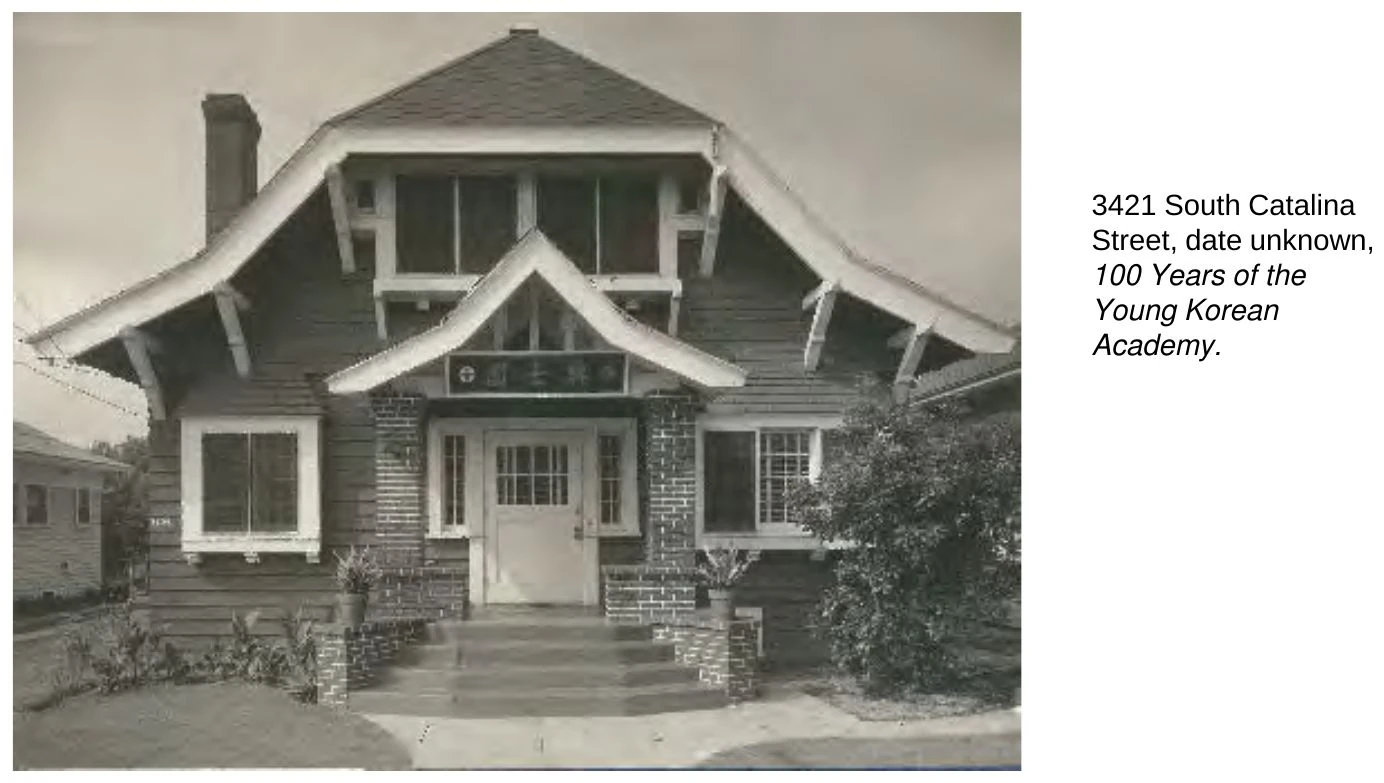
The application, p. 52
Three of the historical photographs are captioned without a date. The captions on pages 44 and 45 say date unknown
, and the one on page 51 reads 3421 South Catalina Street, date unknown
. That is the only historical photograph in the application captioned with the Catalina address, and it has no date and no photographer. Page 37, a portrait of Dosan, is dated c. 1919
. Page 49, one of three spreads of member portraits from the 2013 book, is captioned 1914-20113 [sic]
, which is not a year.
The page 45 print is lettered on its face The Eleventh General Assembly of Young Korean Academy and, on a second line, Los Angeles, with a date beside it that the City’s scan is too blurry to read. Flip Ahn Cuddy pointed this out to the City on 13 September 2021.
He counts the eleventh assembly from the 1913 founding as 1924, and he names his mother Susan, his aunt Soorah and his grandmother Helen Ahn among the group. The photograph is a street scene in front of a commercial building, not the Catalina house.
The application, p. 45
Captioned “date unknown.” The lettering on the print names the eleventh general assembly, in Los Angeles.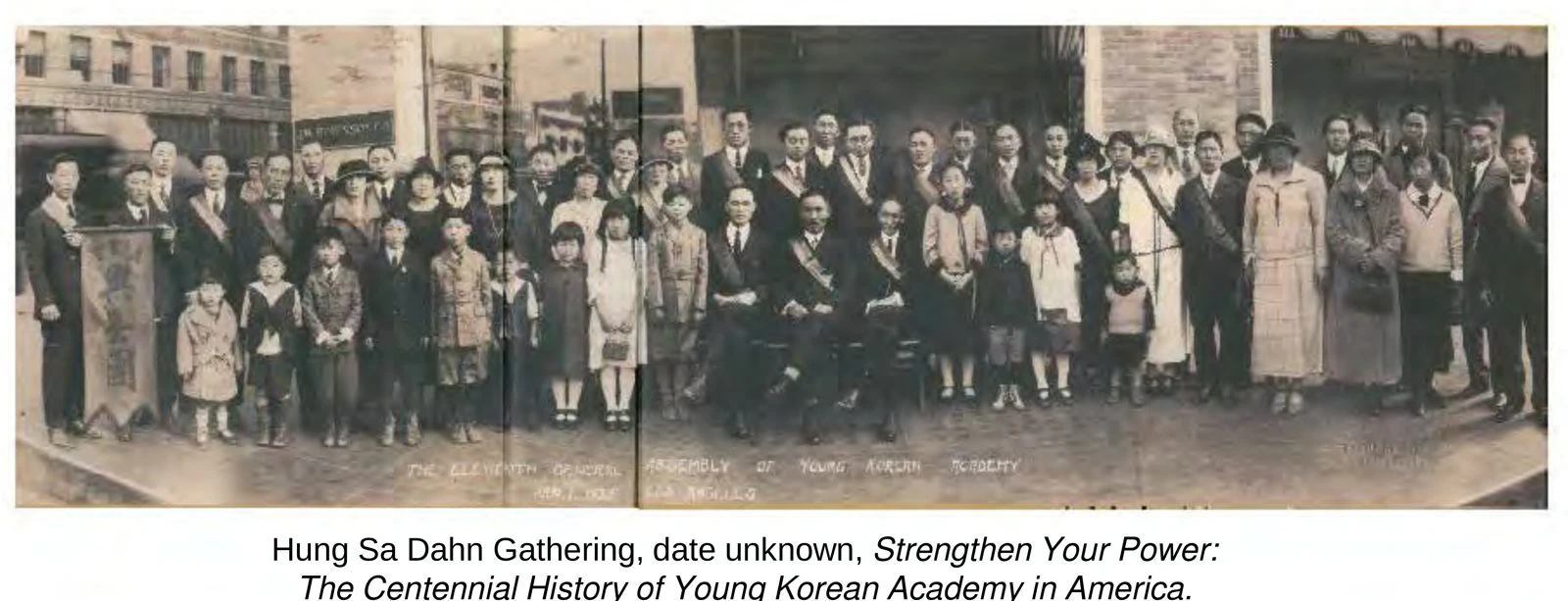
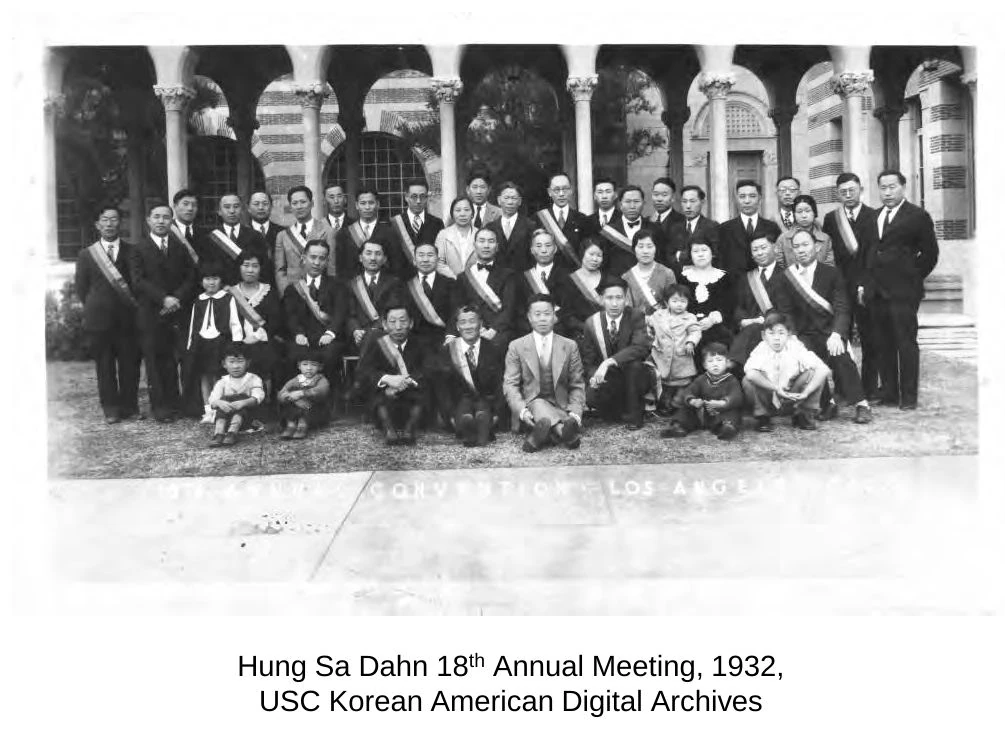
Pages 52 to 61 are annual meeting photographs credited to the USC archive, 1932 to 1961. None of the ten captions names a place. The 1932 photograph (p. 52) shows a group seated and standing before a building with arched openings and columns, which does not look like the house on page 51.
The print on p. 56 is indoors and marked on its face Y.K.A., 12-18-49, Los Angeles, California. The prints of 1937, 1940 and 1943 (pp. 53 to 55), on Flip Ahn Cuddy’s count, show no Ahns, and he says Helen Ahn is at the 1947 meeting and that he has a photograph of her at a 1949 Christmas party.
The ordinal in each caption does not always match its year (see the paperwork table below). The 1937 print (p. 53) shows a group before a gabled porch like the ones in the 1940 and 1943 prints; no caption names the place, so the photographs do not settle the 1936 question either way.
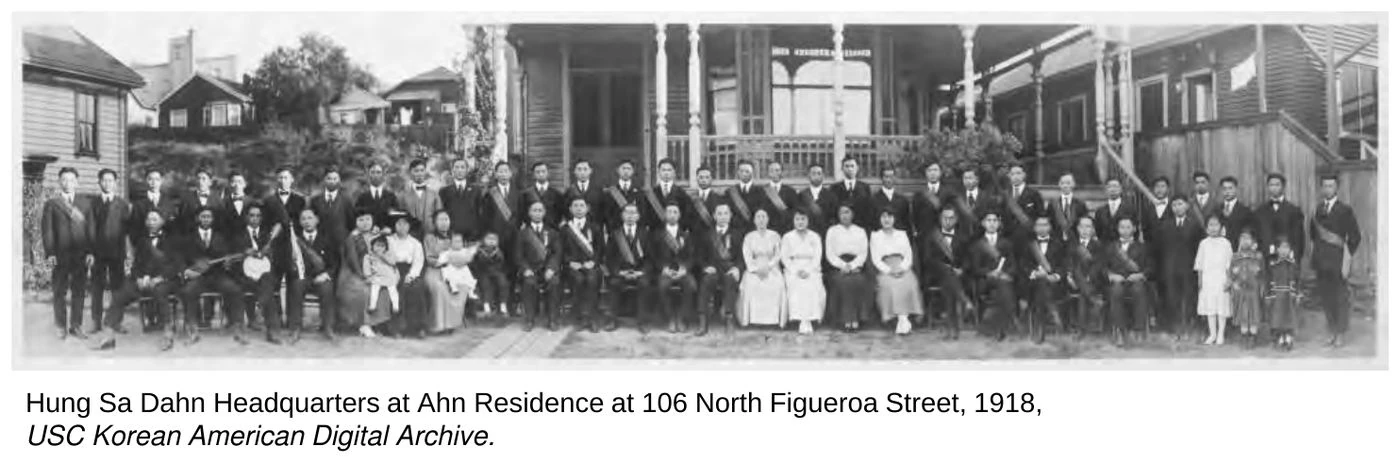
Pages 42 and 43 carry the same caption, Hung Sa Dahn Headquarters at Ahn Residence at 106 North Figueroa Street, 1918
, with two different credits: the USC archive and the 2013 book. The application’s own photographs put the organization’s headquarters at the Ahn residence on Figueroa in 1918, eighteen years before the date the application gives for the Catalina purchase.
Sources: City file pp. 12, 24, 26 to 61, 73; Los Angeles Times, 7 October 1992; Flip Ahn Cuddy, email to Ken Bernstein, 13 September 2021, 10:51 pm; Flip Ahn Cuddy, family statement.
The maps
The file has a divider headed Maps
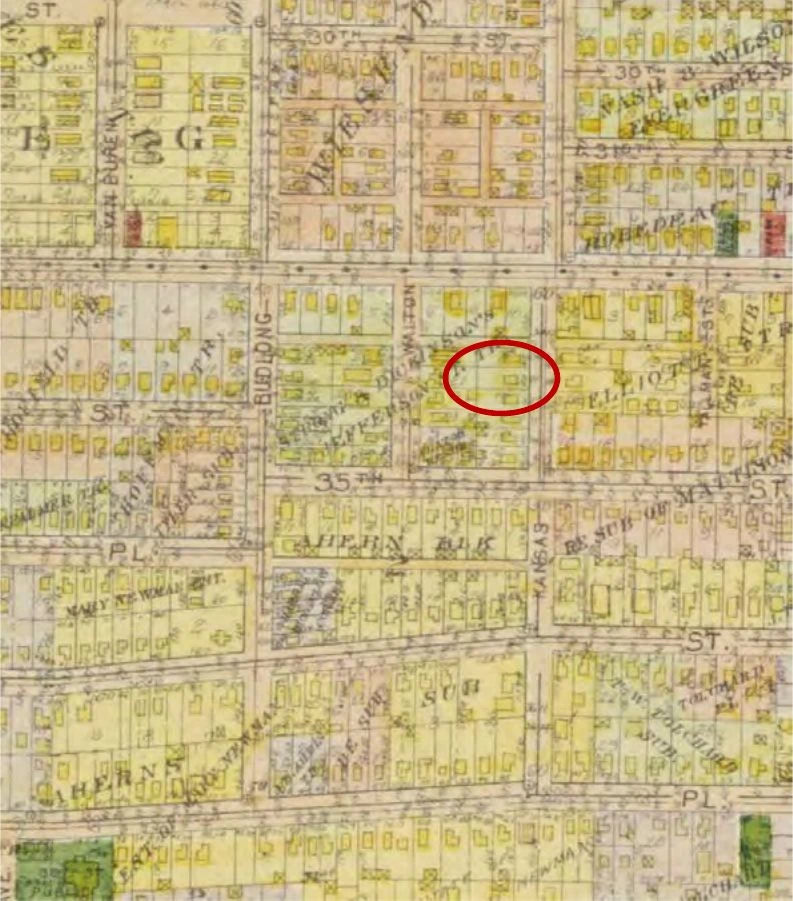
and two map pages behind it. Page 67 is captioned 1921 Baist Real Estate Map
, Plate 18, prior to Kansas Avenue’s renaming to Catalina Street
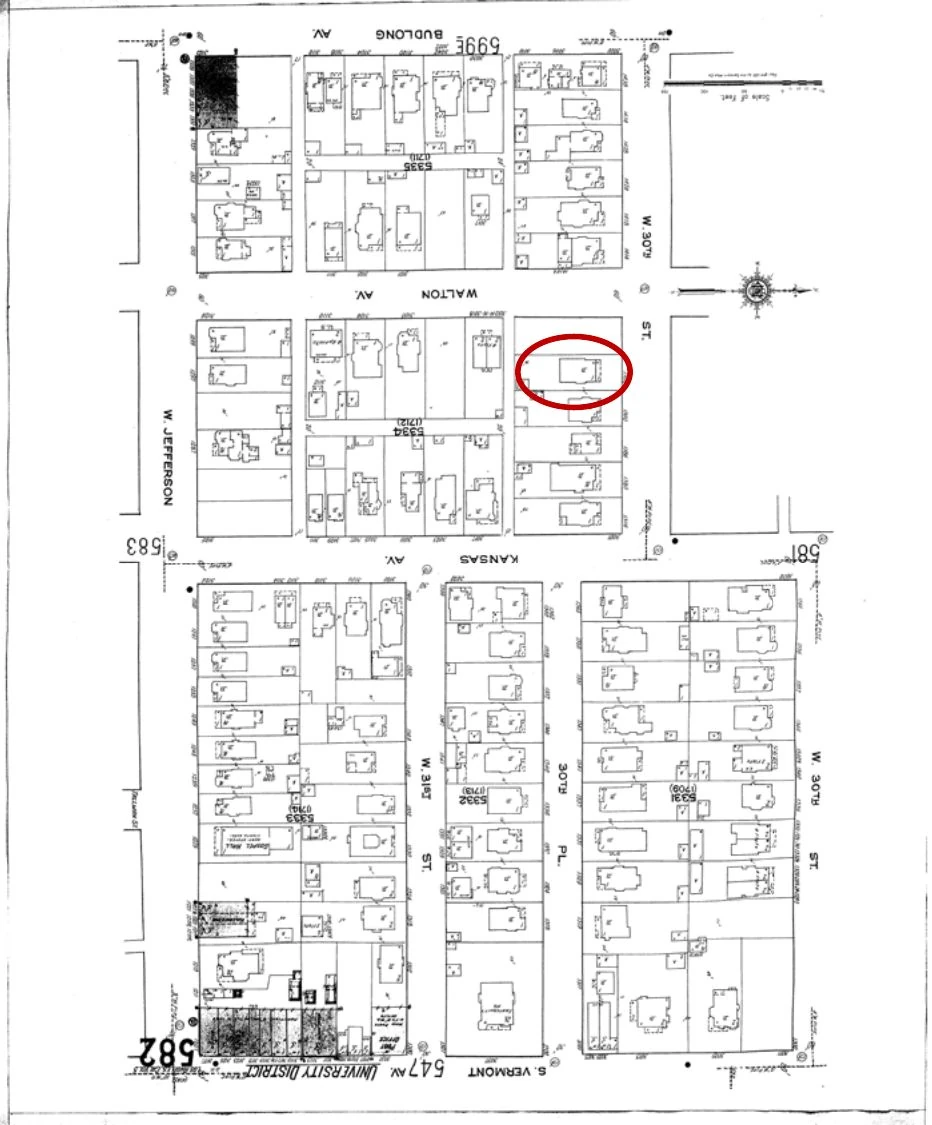
. Page 68 is captioned 1922 Sanborn Map, Volume 6 Sheet 582
, with the same words about Kansas Avenue. Neither caption says when the street was renamed.
The application, p. 67
The application, p. 68
The Baist page is a color plate of street blocks with lot lines and small building shapes. Street names are printed on it, and among those that can be read are 35TH, KANSAS, BUDLONG and WALTON. A red circle marks one spot on a block above the street labeled 35TH. The scan is a small, coarse image, and at this size the lot numbers, the tract name and any owner’s name cannot be read with confidence. The circle holds several building shapes, and the scan does not show which belongs to the circled lot.
The Sanborn page is a black and white sheet of building outlines, and it is turned upside down on the page, so its labels read inverted. Turned around, the street names KANSAS AV., W. JEFFERSON, BUDLONG AV. and WALTON AV. can be read, and the sheet number 582 is printed near one corner.
A red circle marks one lot. Inside it the sheet draws one main building outline, and a second small outline touches the edge of the circle. At this resolution it is not possible to say whether that second outline sits on the circled lot or on its neighbor, so no conclusion about a garage is drawn from it.
The application’s text never discusses either map. The word Baist appears only in the caption on page 67. Sanborn appears in the caption on page 68, in the bibliography as “Sanborn Maps” (p. 24), and in footnote 31 on page 20, which cites a 1922 Sanborn sheet numbered 623 for the Korean Presbyterian Church on West 35th Place, a different address and a different sheet.
What the maps can carry is limited. Both predate the date the application gives for the purchase by fourteen or fifteen years, and both predate the 1932 permit by ten or eleven. Neither shows an owner’s name that can be read on the circled lot.
On the Sanborn sheet the circled lot holds a building, which fits the application’s own date of 1910 for the house (p. 12). They show the application’s preparers had map evidence in hand, and they show the old street name, but they say nothing on who held the lot in 1932 or 1936.
Sources: City file pp. 12, 20, 24, 66 to 68.
Two timelines
Only dates that can be cited on each side.
What the City’s file says
1913
Hung Sa Dahn founded in San Francisco (p. 15).
By 1914
Ahn family in Los Angeles (p. 17).
1926
Dosan leaves Los Angeles for the last time (p. 17).
1927, 1932, 1937
Arrests by Japanese colonial authorities (p. 17).
1932
Interior alteration permit 13253, 16 August (p. 12, fn 2).
1936
Hung Sa Dahn acquires the property; Dosan “imprisoned” at the time (p. 15).
1937
KNA moves its headquarters to Los Angeles; Helen Ahn moves the children to the McClintock Avenue house (pp. 17, 19).
20 March 1938
Memorial service in the Los Angeles City Hall Council Chambers (p. 17).
23 May 1958
Duplex permit (p. 12, fn 3).
1978
Property sold by the organization (p. 23).
What the record shows
1913
Hung Sa Dahn founded in San Francisco (pp. 15, 17, 21; Cha memoir, p. 82).
By 1914
Ahn family in Los Angeles (the application, p. 17).
1926
Dosan leaves Los Angeles for the last time (pp. 4, 17).
16 August 1932
Permit issued for 3421 S. Catalina; owner John P. Lem (p. 63).
25 August 1932
Sinhan Minbo, p. 1, headline reporting that the Hung Sa Dahn acquired a house; no address is legible in our scan.
1932
Dosan seized in Shanghai and taken to Korea (The New Korea, 17 March 1938; p. 17 lists a 1932 arrest).
February 1935
Dosan released from Daejon prison (the chronology the Ahn family provided; The New Korea, 17 March 1938, says “1935”).
July 1937
Dosan imprisoned again (The New Korea, 17 March 1938). The chronology the Ahn family provided dates the arrest to 28 June 1937.
10 March 1938
Dosan dies in Seoul (The New Korea, 17 March 1938).
20 March 1938
Memorial service at University Methodist Church (Sinhan Minbo, 17 and 24 March 1938).
23 May 1958
Duplex permit; owner Hung Sa Dahn (p. 64).
9 June 2003
Re-roof and paint permit (p. 65).
The file against itself
Each sits between two pages of the City file.
Headquarters to 1978, or to 1948.
In the July report page 3 says From 1936 to 1978, the subject property served as the headquarters of the Young Korean Academy
, without saying of what. The final report says From 1936 to 1948, the subject property served as the headquarters of the Young Korean Academy
(final p. 4).
That matches its own sentence on page 7 that Three years following Korea’s independence from Japan in 1945, the global headquarters for Hung Sa Dahn relocated to Seoul, South Korea.
(final p. 7). The final report still dates the property’s use as a community hub, and the organization’s departure from the building, to 1978: the property functioned as a long-standing civic, social, and cultural hub in the Korean American community until 1978
(final p. 6), and the building does not appear to have changed since 1978, when Hung Sa Dahn left
(final p. 7).
The application, which the packet re-attaches unchanged, says only that the headquarters ran from 1936 to 1978
(July p. 15; final p. 95). Page 22 says that after 1945 Hung Sa Dahn’s global headquarters was moved from Los Angeles to Seoul
. Page 4 says the site is significant as the Los Angeles branch of the Korean American patriotic youth organization
. Dr. Cha’s memoir calls it the “U.S. headquarters” (p. 81).
Dosan’s “absences.”
Page 4 says During Ahn’s frequent absences, the organization continued to operate and expand at the subject property
. The file dates his last departure to 1926 (pp. 4, 17) and the property’s acquisition to 1936 (p. 15). On the file’s own dates he had left Los Angeles ten years before the property was bought.
The Ahn home.
Page 39 puts the family at 1411 W 4th St. in 1909, five years before the application says they came to Los Angeles (p. 17). Page 21 puts them at 106 North Figueroa Street by 1917.
What the file gets right
The preparers had no access to the site and say so: No physical description or current photographs of the interior are provided in this application due to the nomination preparer’s lack of access to the site.
(pp. 12, 13). The application also admits what it does not know. Dosan could not see the acquisition (p. 17), and how the house was chosen and bought is unknown (p. 21).
It says the Hung Sa Dahn was founded in San Francisco in 1913 (pp. 15, 17, 21), and Dr. Cha’s memoir confirms it was founded at a Kang residence in San Francisco (p. 82). It records that the Ahn Family Home was moved to USC in 2004 and is Historic-Cultural Monument No. 1059 (p. 18). The 1958 permit names the Hung Sa Dahn as owner of 3421 S. Catalina (p. 64), and it is the earliest document in the file to do so.
Dr. Cha’s memoir, the earliest eyewitness account in the file (Fall 1959, p. 80), says The up stair rooms were rented out to students at a nominal rent.
The application also places The New Korea at the Association hall, not at this house: The Korean-language newspaper The New Korea, with a political bent, was published on site.
(p. 20)
The paperwork: seven smaller mismatches
The application against the documents attached to the file.
| The file says | Page | The attached document shows | Page |
|---|---|---|---|
1958 Re-roof and paint exterior at 3421 South Catalina. | 13 | The attached re-roof and paint permit is from 2003 (permit printed 06/09/03). | 65 |
A one-story detached garagethat appears to have been constructedin 1950, footnoted “ZIMAS.” The staff report on page 3 states it flatly as a 1950 one-story detached garage. | 3, 13 | The ZIMAS report lists Building 1 (1910) and Building 2 (1958) and says No data for building 3. The 1958 permit lists the existing use as “Dwelling” and does not list a garage. | 87, 64 |
Tract named Strong and Dickerson's Jeffersonon the nomination form. | 6 | The legal description is Strong and Dickinson’s JeffersonStreet Tract, Lot 12; the ZIMAS report and the 1958 permit also read Dickinson. | 1, 86, 64 |
Duplex built in 1958 to provide housing for elder founding members of the organization. | 22 | The permit, dated May 1958, gives the owner as Hung Sa Dahn and the purpose as “2 fam Dwelling,” valued at $10,000. It does not mention elders. | 64 |
| Duplex built in 1958 (permit LA-1753, 23 May 1958). | 12, 22 | Dr. Cha’s memoir: Some years after the 1960 (I can’t remember exact year), I noticed a duplex being built in the back of the lodge. | 82 |
Duplex style Modern-style duplex. | 12 | Page 3 calls the duplex Minimal Traditional. | 3 |
| Photo captions give the 27th annual meeting as 1940 (p. 54), the 29th as 1943 (p. 55), the 36th as 1949 (p. 56), the 40th as 1954 (p. 57), the 42nd as 1956 (p. 59) and the 47th as 1960 (p. 60). | 54 to 60 | Counted year by year from the 27th in 1940, the 29th falls in 1942 and the 40th in 1953. | 54, 55, 57 |
Sources
City of Los Angeles, Department of City Planning, Recommendation Report and Historic-Cultural Monument application, case CHC-2021-5125-HCM, hearing date 15 July 2021, 91 pages: pp. 1 to 25, 26 to 61, 63 to 70, 73, 75, 79 to 82, 86, 87.
City of Los Angeles, Cultural Heritage Commission agenda packet, case CHC-2021-5125-HCM, hearing date 4 November 2021, 171 pages (PDF): final pp. 2 to 8 (final staff report), 54 to 80 (owner’s correspondence), 81 to 85 (July staff report), 86 to 171 (application).
City of Los Angeles, Council file 21-1349 (lms.lacity.gov): Cultural Heritage Commission letter to Council, 16 November 2021 (PDF); Commission Findings (PDF); Planning and Land Use Management Committee report, 21 February 2023 (PDF); Official Action of the City Council, 28 February 2023 (PDF).
SurveyLA, Korean Americans in Los Angeles, 1905-1980, Historic Context Statement, City of Los Angeles Office of Historic Resources, August 2018, 94 pages (PDF).
Sinhan Minbo (The New Korea), Los Angeles: 25 August 1932, p. 1; 17 March 1938, p. 1 and English page; 24 March 1938, p. 1 and English page. Scans from the USC Digital Library; the 25 August 1932 image is a 600 dpi scan provided by the team.
Ken Bernstein, Office of Historic Resources, City of Los Angeles Planning, email to Flip Ahn Cuddy, 13 September 2021, 6:09 pm (email addresses omitted). From Flip Ahn Cuddy’s email records; not part of the City packet.
Edward T. Chang, letter to the Cultural Heritage Commission, 2 November 2021 (copy). Forwarded to Flip Ahn Cuddy by Tom Byun on 2 November 2021; not part of the City packet.
Los Angeles Times, 13 March 1938 and 7 October 1992, as attached to the City file (pp. 70, 73).
Flip Ahn Cuddy, email to Ken Bernstein, 13 September 2021, 10:51 pm, with notes on the photographs on City file pp. 40 and 45 (email addresses omitted). From his email records.
Philip “Flip” Ahn Cuddy, grandson of Dosan Ahn Chang Ho: Chronology of Dosan’s Leadership, 10 November 2025; family statements, October 2026.